by successfulbob | bird photography, Lumix G9, LumixGH5, photography, photography gear, travel photography, wildlife photography
Bosque Del Apache National Wildlife Refuge
Snow Geese Part Two
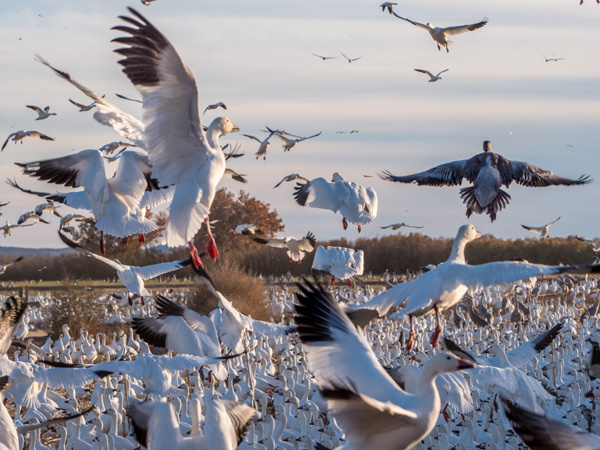
With twenty-thousand plus snow geese winging their way around the Bosque Del Apache National Wildlife Refuge it was a fantastic couple of days of sights and sounds. Sometimes it was quite overwhelming. On several occasions I had to put the cameras down to just experience nature in its pure form.
I’ve found there is a layer of distance that appears much larger than the six to eight physical inches when I put my face behind a camera — a certain detachment. This distance enables other photographers and me to do things like cover disasters, wars or record infant demises through organizations such as **Now I Lay Me Down To Sleep. This is an important feature, but it can occasionally interfere with the enjoyment of the moment that is unfolding in front of us.
More Snow Geese photos to share…
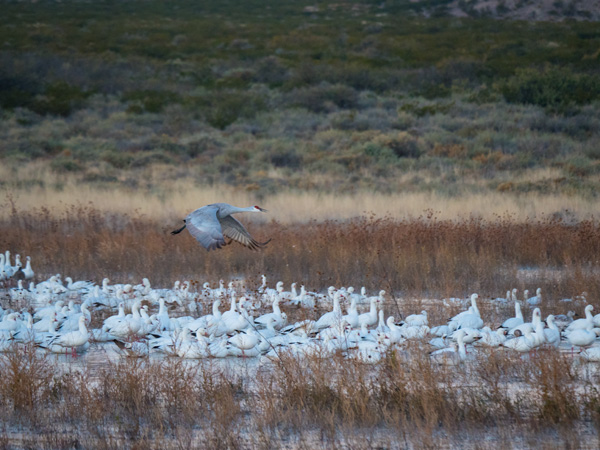 A solitary Sandhill Crane glides in over a pond of snow geese
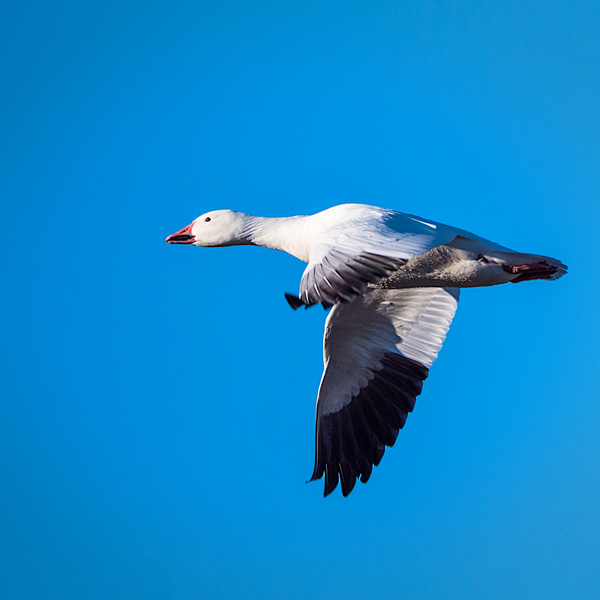
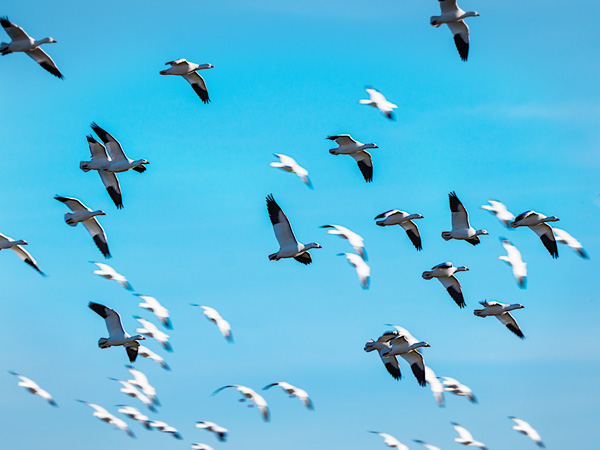 Snow geese in flight
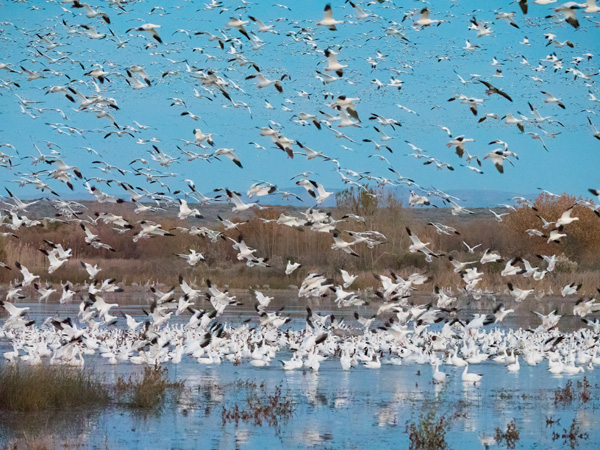 Take off!
 Kinda reminds me of that famous movie from Alfred Hitchcock!
To make successful wildlife photographs, I would suggest that you spend a fair amount of time studying their behavior long before you pick up your camera to try and capture images. I’m a big fan of bird behavior vs. a straight portrait, although portraits have their place. Being able to predict when a bird will fly, open its wings or display for another will make your photographs come to life. Having a lens with a long reach works to help you fill the frame without disturbing the natural behavior. See my gear below which gives me an 800mm equivalent which is handholdable for capture.
Images were made with Panasonic cameras. Most often the LUMIX G Leica DG Vario-Elmar Professional Lens, 100-400MM, F4.0-6.3 ASPH mounted on the Lumix G9 and the Lumix GH5 for a second body. I had the chance to try out the Leica DG Vario-Elamarit 50-200mm 2.8-40 lens I am working toward getting this lens.
Next up the Sandhill Cranes!!
Yours in Creative Photography, Bob
** If you want to give back to your community think about photographing for NILMDTS. It is a very rewarding, if difficult mission.
by successfulbob | photography software
It’s Deal Time with Luminar Software
If you haven’t given Skylum’s Luminar a chance as yet it might be time. It sells for $69 (or if you use coupon code COATES $59) It works as a stand-alone program or as a plug-in on MAC and PCs. This software can be a great time-saver and/or artistic tool. Lot of goods stuff including… Ah, I don’t need to ‘splain it to you. Check out the link it’s all there and worth a look!
 Click here or the image above
Happy Thanksgiving!
Yours in Creative Photography, Bob
PS – This Black Friday deal comes with other goodies too!
by successfulbob | bird photography, Lumix G9, LumixGH5, photography, photography gear, travel photography, wildlife photography
Festival of the Cranes
Bosque Del Apache National Wildlife Refuge
White Snow Geese must have gotten the invitation too.
I was in Socorro, New Mexico at the Festival of the Cranes hanging with the massive flocks of birds and a mass of photographers. Gotta tell you I felt like the Snow Goose whisperer during my workshop. The 10,000-plus Snow geese seemed to be following me around the refuge. Seeing them move as a group and fly mass ascensions from place to place was magical! Here are a few photos to help visually tell the story.
 If you look closely, you can see the water droplets on the goose’s body
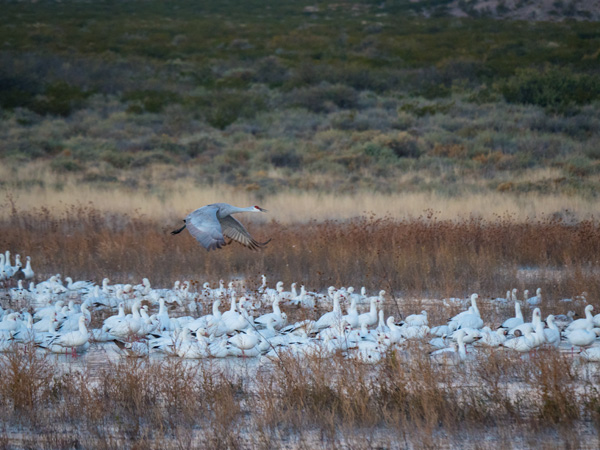 A sandhill crane works to land over a pile of snow geese. The guides at the Festival of the Cranes consider the geese interlopers. (And there were about 20,000 plus!)
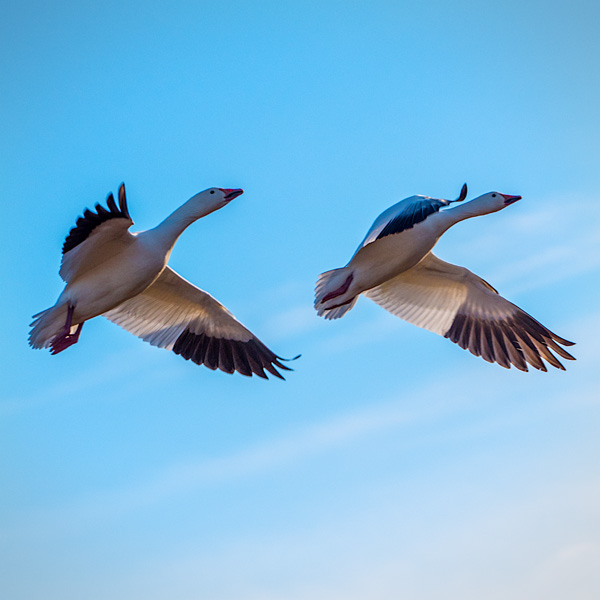
 A pair of snow geese in flight
This trip is my second time at the Bosque Del Apache National Wildlife Preserve, and I certainly hope it won’t be my last. It is a well-managed area with wildlife throughout the year. Each year the cranes and geese return on their annual migration just before Thanksgiving. It is a sight to behold when 20,000 geese take to the air. I’ll share some photos of that spectacle in a day or so. To tell the truth, I stopped making images for a while to experience the display of so many birds in flight, or as my friend, Skip Cohen says, “Take ‘Neurochromes’ and burn the images into your brain.”
Images were made with Panasonic cameras. Most often the LUMIX G Leica DG Vario-Elmar Professional Lens, 100-400MM, F4.0-6.3 ASPH mounted on the Lumix G9 and the Lumix GH5 for a second body. I had the chance to try out the Leica DG Vario-Elamarit 50-200mm 2.8-40 lens I am now lusting after this… A sweet piece of glass!
Have a happy Thanksgiving!
Yours in Creative Photography, Bob
by successfulbob | infrared photography, landscape photography, Lumix G6
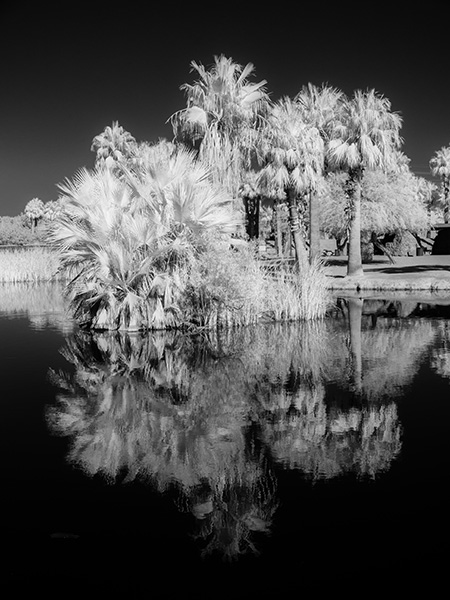
Papago Park, Phoenix Arizona
Infrared Imagery
When the sun is high in the sky, and the contrast makes for images that would be too ‘eh’ for making regular color photos it’s time to break out the infrared camera. Infrared is soooo much more natural to capture with a digitally converted camera with Live View. The Live View allows you to see in real time how the image will look in black and white. This is a massive thing as even to try to focus when we were capturing Infrared photos in the film days your filter had to be so dark that you would need to remove it to focus. AND, there would be an adjustment that you had to apply because IR capture focused on a slightly different plane from your regular focusing.
Enough about the past hassles of IR capture here are a couple of images I made yesterday at Papago Park.
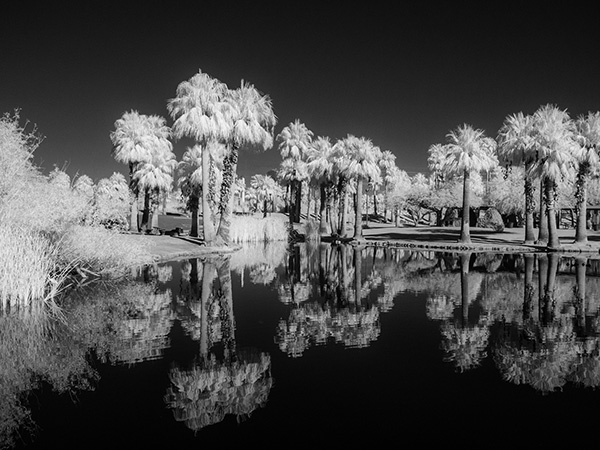 I quite enjoy the high contrast of the water and sky with the light palms
 The IR converted camera file initially comes out a magenta file, so it needs some massaging in Adobe Photoshop to be the BW we’ve come to know and love.
Some Notes on How I processed these images
There are lots of convoluted processing possibilities to getting the IR look. In this case, I’m coming up just a wee bit short on the full IR feeling, but I like the results. In Photoshop I remove the color by decreasing the saturation, adding Clarity, opening shadows or highlights. I also adjust the Temperature slider making the blue sky and the water reflecting the blue sky darker.
As a final touch, I use Luminar 2018 as a Plug-in and add an Orton Effect or possibly a Glow depending upon the image feel for which I am going.
Camera is the Lumix G6 (using an older camera collecting dust on your shelf for conversion is fine as long as it has Live View) Conversion done by LifePixel. There are varieties of IR filters you can choose to check out the info here. I have gone with the old standard.
If you have any questions, give me a shout.
Yours in Creative Photography, Bob
by successfulbob | bird photography, Lumix G9, photography, photography gear, travel photography, wildlife photography
Bombay Hook National Wildlife Refuge – Smyrna, Delaware
I’ve been a bit remiss in posting. Travel for speaking. Travel for family visit. And catching up upon return fronfrom the travel makes Bob a bad boy. But, I’m back and with plans to have more posts even when traveling to judge images &speak in Oregon and do a seminar and a couple workshops for the Festival of the Cranes in Socorro, New Mexico in the middle of November. We’ll see how that works out!
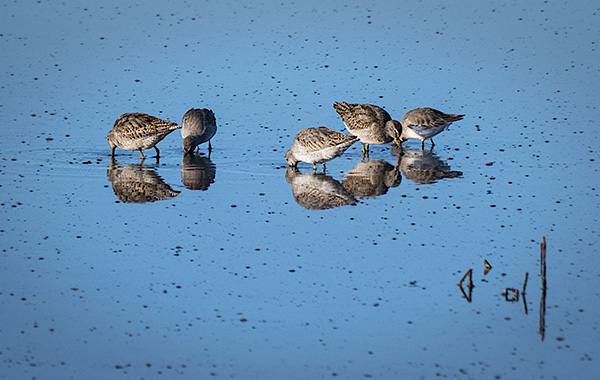 Dunlin Sandpipers enjoying breakfast
While on the family visit I made it up to the Bombay Hook National Wildlife Refuge. I spent the day making images and talking photography with my friend Ned Levi. This was the first time we met in person. I highly recommend spending quality time with your peers. It’s wonderful how much you can learn from each other. (learn more about Ned and his blog)
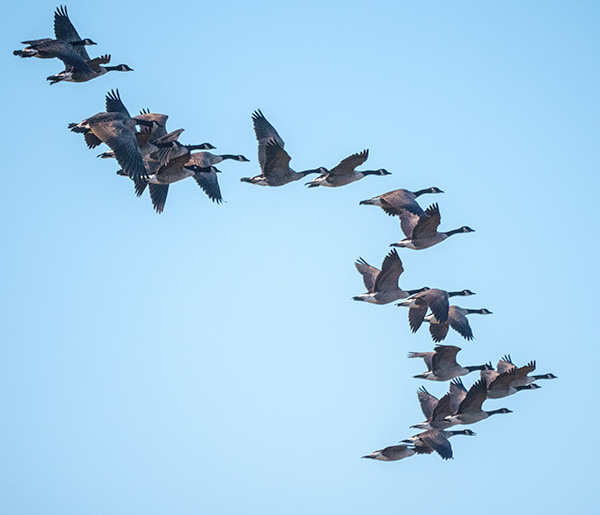 Thought this was an interesting formation of the Canada Geese. I normally enjoy them mor eisolatedbut the overlap of the birds is kida cool. Watcha’ think??
If you have not spent time in wildlife refuges there are some protocols that make the system work for everyone. If you do go please follow the rules and regs. use the longest lens you have and do your best to not disturb the wildlife. There’s an expression, “Take only images, leave only footprints.” Not sure I have the exact words but you understand the sentiment.
This is from the Refuge website and the rules are much the same in all refuges.
Know Before You Go
- The wildlife drive is open from 1/2 hour before sunrise to 1/2 hour after sunset daily.
- The visitor center is open weekdays from 8:00 a.m. to 4:00 p.m. year round.
- During spring and fall weekends, the visitor center is open Saturday and Sunday from 9:00 a.m. to 5:00 p.m.
- The visitor center is handicapped accessible and has educational displays and videos.
- The visitor center is closed on Federal Holidays.
- The visitor center is closed on weekends during July, August, mid-December, January, and February.
- Check the website or call to find out about refuge road closures during bad weather and hunting season. During summer months, visitor should bring insect repellent and wear long-sleeve shirts and long pants.
- To protect wildlife and their habitat and to provide the best opportunities in wildlife observation and photography, it is important not to disturb, injure, or damage plants and animals on the refuge. In fact, it is a prohibited act as stated in 50 CFR 27.51. This disturbance includes flushing birds and other wildlife or using mechanical or electronic devices to lure birds closer for observation or photography. Please remember to take only memories and photographs and leave only footprints.
- Unmanned aircraft systems (Drones) are prohibited.
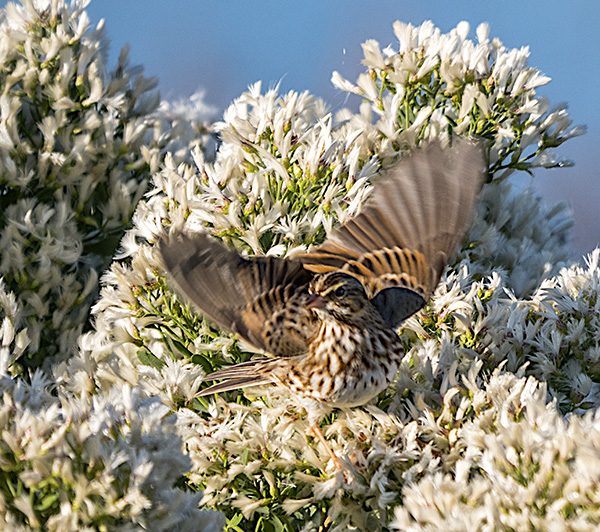
 A simple houe wren was dancing in and out of the flowering bush. Behavior and movement photos are my aim.
Images were made with the PANASONIC LUMIX G Leica DG Vario-Elmar Professional Lens, 100-400MM, F4.0-6.3 ASPH mounted on the Lumix G9.
Yours in Creative Photography, bob