by successfulbob | photography, photography - art quote, photography education
While I wouldn’t trade my time in the darkroom for anything I do appreciate that my darkroom has come into the light via my computer.
Today’s quote from John Sexton about the magic of trying to pull a print and the frustration & fun that lies therein is something that I now experience in working to create my fine art photo pieces in the computer. The difference is I have many more tools available at my beck and call… and the ability to repeat a print much easier. In the past I remember trying to pull a print like one I had already made and with the vagaries of dodging and burning and shifting chemistry making it near impossible to duplicate the exact tones.
Is this a good thing? It’s definitely different but I believe so. The idea is to get the image that is pre-visualized onto a media to share with others. We now have the tools to touch every single tone in an image giving us the ability to really make a print sing! I saw a quote from Ansel Adams in his auto-biography that he wished he could be around in 20 years (published in 1984) to see what others could get from his negatives via electronic means. It wouldn’t be the electronics but the operator that would be making the difference. He said that the images wouldn’t be like his but that people might very well get more from his negatives than he could in the darkroom.
I enjoy the challenge of sharing my imagery… no matter the way it is eventually created. The result is what counts, not the way in which it is achieved.
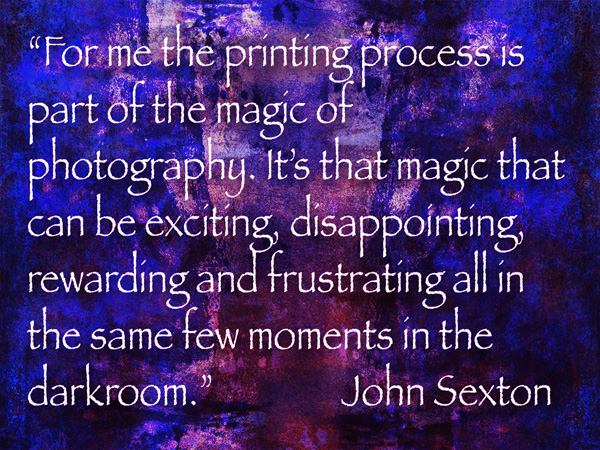 “For me the printing process is part of the magic of photography. It’s that magic that can be exciting, disappointing, rewarding and frustrating all in the same few moments in the darkroom.” John Sexton
by successfulbob | photography education
Today’s quote is from Wayne Miller.
“I think good dreaming is what leads to good photographs.” I have to agree. When I let my mind run free pursuing ideas for a different photographic image good things happen. I believe that’s because in dreamworld, whether it be day-dreaming or full on dreaming while in the sleep state, there is no negativity. No one saying, “You can’t do that.” Or, “That’s not possible.” Or, “Nobody will like that.” The ‘Negative Nellies’ are not present in dreams. Now the only secret is to bring that idea out and execute it before anyone has a chance to knock it! Dream on!
I didn’t know who Wayne Miller was, I just enjoyed the quote… which led me to find out Wayne was born in Chicago, was a combat photographer in WW II working in the unit with Edward Steichen. He was also a contract photographer for Life Magazine and was president of Magnum Images for a time and helped with the Family of Man photography exhibit in NYC. In other words he was a trail blazer for photographic imaging. Wayne made it to the age of 94 before passing away in May of this year.
by successfulbob | Lumix GX7, Lumix Lounge, photography education
I went to visit the Sedona Airport for a WW II USO show put on to promote the Sedona Wine Fest. It was very well put together. WW II planes including a B 25 were on display and Sedona’s local songstresses Shondra Jepperson, Jeanie Carroll and Susannah Martin played the stage dressed for the part with WW II uniforms. They sounded wonderful. Other characters like Rosie the Riveter, a Detective, Jane Mansfield and others from the era were played by local Sedona actors and it was a blast. You can see images from the fun here. In the dialog box add your email. The password is 092013 The BW tone you see on some of the photos is a tweaked preset on the Lumix GX7.
Here’s a sequence I made with Shondra using the 10 fps burst mode with a preset tweaked to black and white on my Lumix GX7 then turned into sepia and animated gif. The animated gif was created in Photoshop using images imported into the timeline.
That girl can swing!
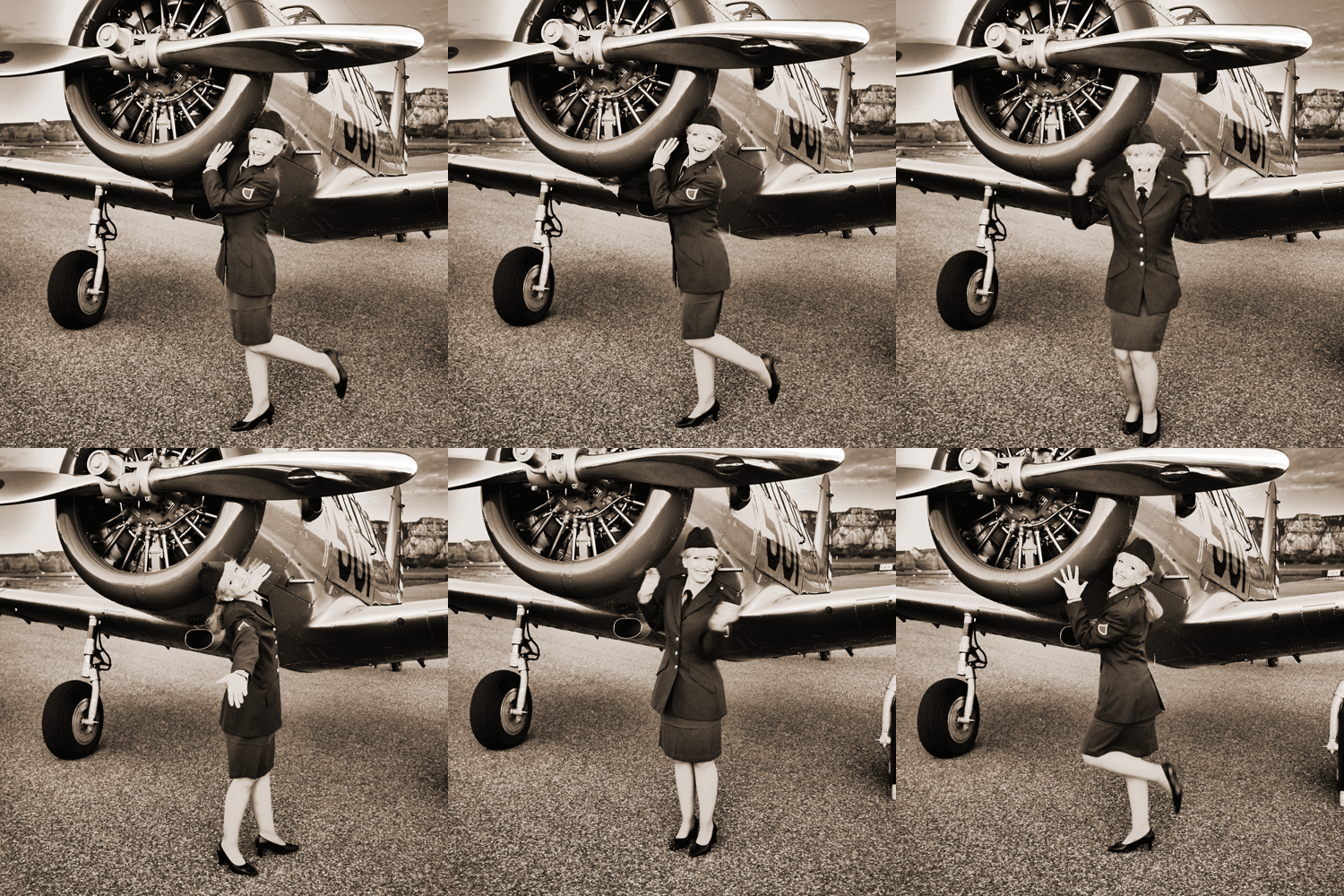 (you might have to wait a little bit for this to download)
And a little feedback from Shondra…
“Hey Bob!!
This is HYSTERICAL!!! VERY cool how you captured this.
THANK YOU SOOOOOOO Much for taking photos of all of us!! Can hardly wait to see the rest of them!
BIG Hugs,” Shondra
I donated my time shooting and processing these images and video in support of the event…
by successfulbob | photography education
I spend time looking for inspiration for the art of my photography away from our industry. While I am often inspired by wonderful photographic images and ideas from other photographers I don’t want my thinking to become completely ‘inbred’. Here’s an artist I follow who has inspired me in different ways on a regular basis. Robert Genn’s Twice-Weekly Letter. You can sign up here. In this post I am sharing here Robert gives credence to the afternoon nap as a tool of creativity. I like it!
Take a nap
September 24, 2013
Dear Bob,
I’ve always been keen on “don’t rest–run.” Often a quick jog after lunch seemed to perk me up and send me back to the studio with a new sense of adventure. Now I’m not so sure. Strictly between you and me, I’m now taking naps.
This follows recent research into the value of sleep, especially short sleep. Sara C. Mednick is a sleep researcher at the University of California, Riverside. Her studies look at the relationship between napping and performance. Mednick thinks humans have a biological need for an afternoon nap. She’s the author of Take a Nap! Change Your Life.
It’s not just the need, it’s the benefits. In sleep our minds become highly active. In sleep we apparently improve our creative ability by uncovering novel connections among seemingly unrelated ideas. Sleep also enhances performance, learning and memory. According to Mednick, after sleep, people are 33 percent more likely to be creative.
Google, Cisco Systems and Proctor & Gamble have now installed Arshad Chowdhury’s “EnergyPods.” These are smart looking recliners with egglike hoods that block noise and light, allowing employees to take naps at work. These companies find that a little sleep helps “reset” the brain to look at things from a different perspective.
According to Mednick, the best time to nap is after lunch. This is the time when most humans and animals experience what is called “the post-prandial dip.” It’s a low-ebb for cogno-processing and physiological responses–when a lot of us actually do feel sleepy. Naps, Mednick found, improve cognitive performance better than caffeine.
I’d be interested if any of our readers have had experience with this. In my case Dorothy the Airedale and I go into the house and nap in a spare room. I read a bit first, preferably something unrelated to art, then I just turn over and snooze. Dorothy doesn’t need to read first. Actual nap time is from 20 minutes to an hour. If the house phone rings, the spell is broken for both of us.
Returning to the studio, I quite often see right away what’s wrong with what I’m doing. Other times I’m driven to start something new. As an early morning riser I’m often petered out after lunch, but I can report that an afternoon nap gives Dorothy and me two days for the price of one.
Best regards,
Robert
PS: “There are biological dips in our rhythm and in our alertness that seem to go along with the natural state from way back when.” (Sara C. Mednick)
Esoterica: At least two methods awaken the potential of a nap. One is to pose a problem before you drift off. Notes unanswered on a pad of paper do the trick. Fresh in the top of the mind, the underground mind works on the notes as you snooze. The second is to go to sleep with nothing much on your mind at all (the purpose of neutral reading beforehand) and let the old subconscious mix and match where it will. “‘Scuse me, I gotta’ go.”
by successfulbob | photography - art quote, photography education
Think about images that stay with you.
Here’s one of mine. I remember a framed Cezanne print that hung in the dining room when I was growing up. It was a simple table setting called Apples and Oranges done in muted yet attractive colors. Under the table was a shadowy figure and I was always curious what that person was doing there. I found an air of mystery that tended to haunt me after playing back the image in my mind.
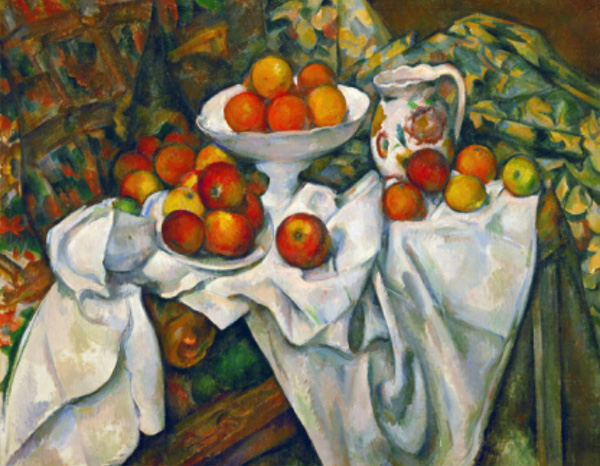 Apples and Oranges available as a print here.
Another was from the Philadelphia Museum of Art. It was an almost life size painting of a bedoin prince in white robes. He was adorned with jewels. The lighting? Exquisite! The rendering by the artist of the metal and details like the hair on his knuckles was stellar. I thought it was possible that I was just amazed by this art because of it’s size. Not true. Upon revisiting this art several times I am continually amazed by this piece.
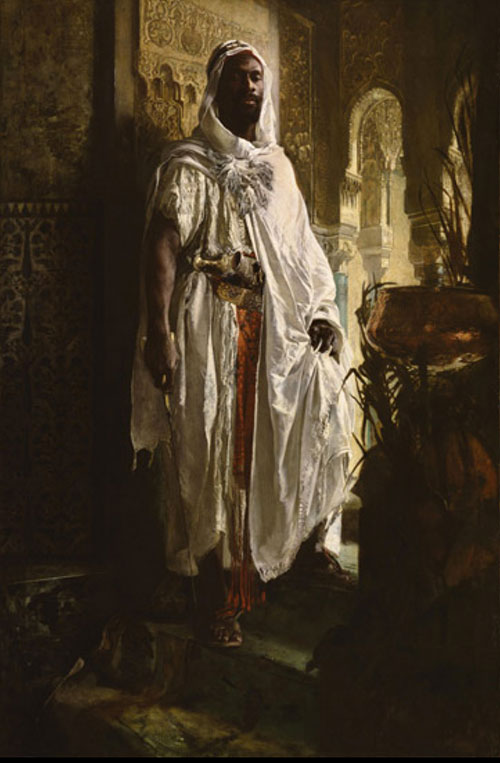 Moorish Chief at the Philadelphia Museum of Art by Austrian Eduard Charlemont
Oil on panel 59 1/8 x 38 1/2 inches (150.2 x 97.8 cm)
Photographs that captured your attention and keep coming back to visit in your mind. They usually have touched a cord inside of you for one reason or another. I believe that Paul Cezanne has given us twelve words and a thought process that will help us to create better, more memorable images. Start with the emotion and find a way to tell the story more deeply and people will find your images more memorable.
How to get the emotion into your image? I suppose it depends on the emotion you are trying to elicit in the viewer. Happy, sad, love, jubilant, sad, placid, agitated, angry, frustrated (don’t ask flight attendants at the end of a four day run for emotional words)
A quick trip to Wikipedia say about emotion: …Emotion is a subjective, conscious experience characterized primarily by psychophysiological expressions, biological reactions, and mental states. Emotion is often the driving force behind motivation, positive or negative.An alternative definition of emotion is a “positive or negative experience that is associated with a particular pattern of physiological activity.”
I find that images that have shadows have more depth and tend to strike a cord more deeply than those that are brightly lit. Bright colors elicit energetic thoughts. Bright colors with wonderful shadows are even more powerful. Shadows with a soft edge transition tend to be more pleasing than high contrast shadows which tend to jar the viewer. Somber, muted, warm tone colors convey quiet.
The idea here is to begin to think of the emotion first then figure the best way to convey it. Now, how will I create a Tango image that shows all the power and grace of the movement??? Time to start thinking… thanks to Paul.
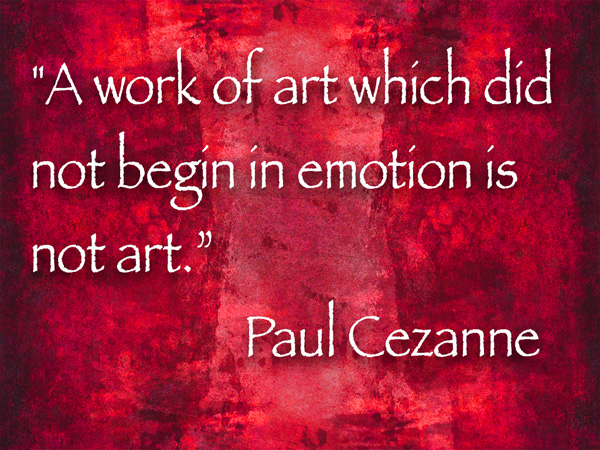
“A work of art which did not begin in emotion is not art.” Paul Cezanne
by successfulbob | fine art photography, Lumix GH3, Lumix GX7, Lumix Lounge, photography, photography education, photography seminar
What a great group in Michigan. Friendly, fun and really important – attentive when class was in session. Shared my ‘Photo-Synthesis’ Fine Art Photography program with PPM. Spoke about 4 1/2 hours. In addition to the Photoshop techniques I shared how much I like the small size and nice files to work with from my LumixGX7 and GH3.
Below are a few testimonials from the students about the program and presentation style. It was fulfilling on many levels from garnering new friendships, learning from the older members who shared their stories and adventures in photography, and being able to give back to the industry that has given me so much. Kudos to Panasonic for sponsoring my sharing to other photographers…
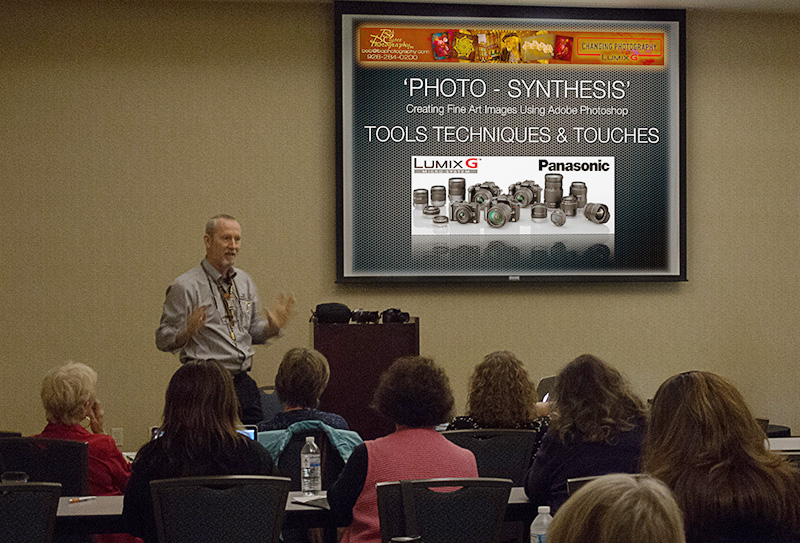 Photo courtesy of Carol Fabrizio, M.Photog. Fabrizio Fine Art Photography Flushing, MI cfabriziophoto.com
“I’m Darcy current president of the professional photographers of Michigan and Bob Coates was at our annual convention and Bob was awesome. Let me tell you we learned everything and my brain is just fried right now. We learn a ton from Bob. From beginners to experts, all took something home to help with their art. I recommend Bob highly to any organization that wants to hire him.” Darcy Olson, CPP – Darcy Olson Photography
“Hi Bob;
Your presentation at PPM Fall Focus Monday afternoon was awesome. It is probably the type of program that should be enjoyed first thing in the day and not after lunch as you present so much material, that I reached brain overload well before you stopped….. Your passion and high energy is definitely infused in your presentation.”
Steve