by successfulbob | photography, photography - art quote, photography education
“I’VE BEEN FRAMED!!”
You’ve seen this line used in many books and movies by criminals, or those thought to be criminals.
Much the same idea Gary Winogrand brings forth the thought that what we choose to put in or leave out of the frame can change the story and impact of an image. It can be as simple as taking the time to think about the background and taking slight a step to the right or left to simplify the area behind the subject. Or it could be taking the subject to a totally different environment to tell a completely different story.
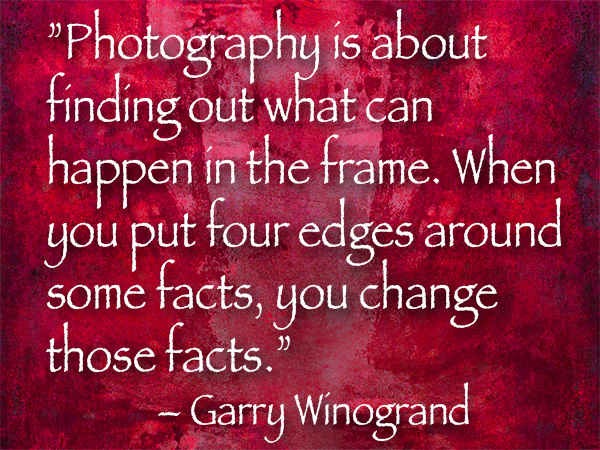
“Photography is about finding out what can happen in the frame. When you put four edges around some facts, you change those facts.” Gary Winogrand
Winogrand was a street shooter, advertising photographer, photography instructor and student of the photographic medium. He’s worth a look at to inspire some deeper thinking in how we use photography to skew our stories, for good or bad, when we press the shutter button.
Yours in Creative Photography, Bob
by successfulbob | landscape photography, lens baby, Lumix GX8, Lumix Lounge, panorama, photography
Da#M it!
I got all the way up the hill to the cliff dwellings and realized I left the fisheye from Lens Baby in the car. Gotta tell you I almost didn’t go get it. I also gotta tell you it probably isn’t such a great idea to run 15 minutes up a steep hill at 7500+ feet. I was sucking some serious wind when I got back up to the top.
Annnnyy waayy… I thought I try some different things with the fisheye lens because of the relatively small spaces in the caves. Once I got my breath back I mounted it on the Lumix GX8 and here’s what I started to play with.
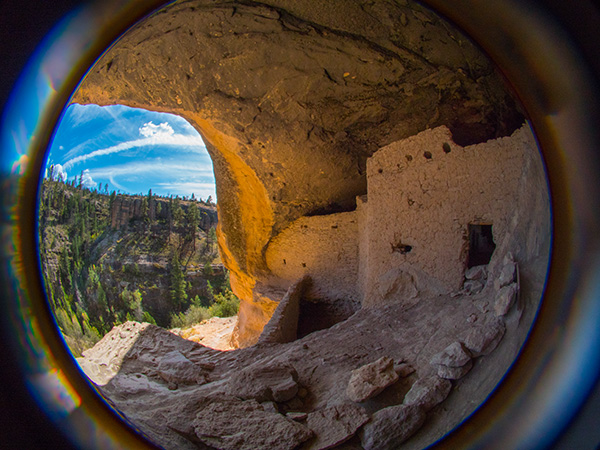
Here’s a ‘straight’ Circular Fisheye image from the dwellings. The full fisheye effect is a little cut-off because of the micro 4/3rds format.
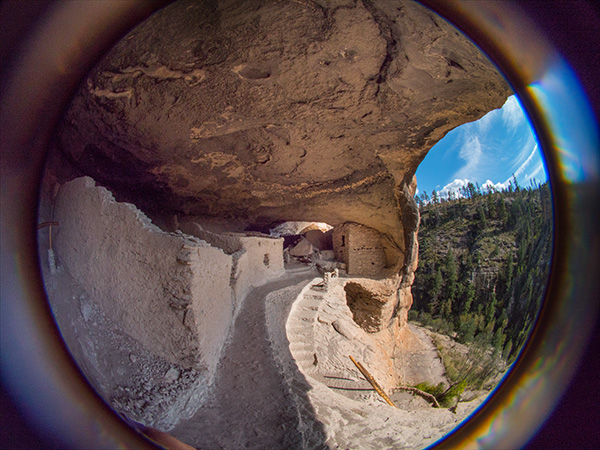
Gila cliff dwellings photo captured in a different way with the Lens Baby
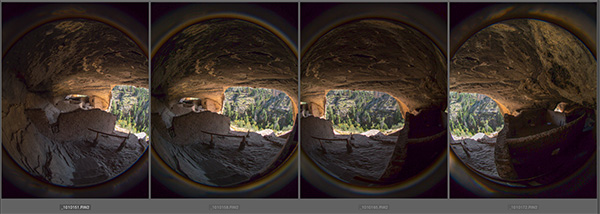
Then I thought I’d try to push the envelope a bit further an do a panorama. Here’s the individual captures…
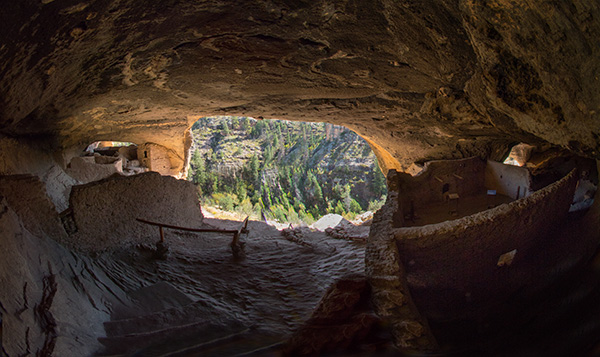
And the stitched image… Don’t try to have Photoshop stitch this for you it locked up on me. I guess the circular edges gave it fits so I did the stitching the old fashioned way… by hand with masks.
I enjoy trying new and different things and was surprised by the final result.
Experiment.
Play.
Have fun.
Make mistakes.
Learn.
Yours in Creative Photography, Bob
by successfulbob | infrared photography, landscape photography, Lumix G6, Lumix Lounge, photography, photography creativity, photography education, photography gear
While on the mountain trip we rode off through the wilderness. Can you say “Curvy Roads!” boys and girls?
Lots of winding roads through the area but it led to some beautiful places. I had the Lumix G6 that has been converted to Infrared capture by LifePixel. It gives the image a pinkish cast straight out of the camera. I’m starting to find my groove in processing for the final Infrared photo look I am going for…
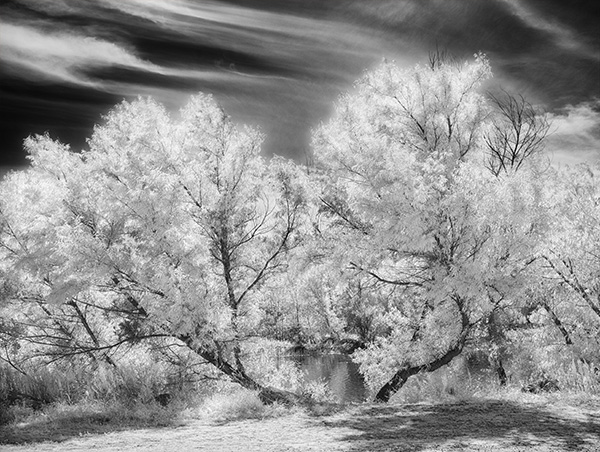
I enjoy how these trees framed a little window into the water beyond.
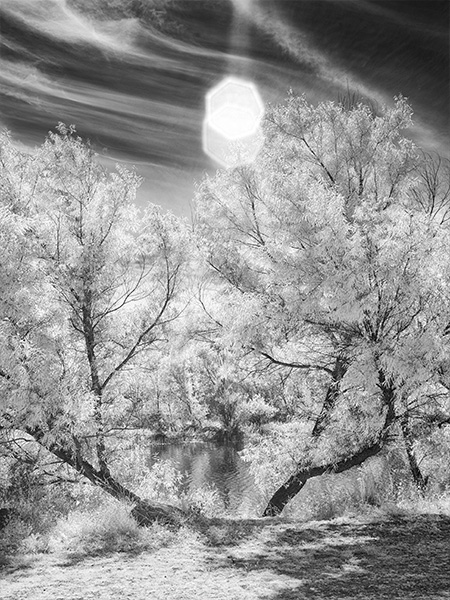
Same trees different composition with a witness to how careful you need to be in shielding your lens from a direct sun hit. Although in this case I think it’s a happy accident and enjoy the flare that found its way into the frame.
Here’s my workflow at the moment as I learn more how the camera ‘sees’ IR light. I capture the scene in RAW plus jpeg with the camera set to capture a black and white image. This give me a pretty good preview of what the IR image will look once it is processed. But since I am capturing the RAW images at the same time I also get all the information that was presented to and captured by the camera for tweaking in post processing. Having all the color information in different channels allows for some very specific processing that would not be available if only the Luminous information was saved.
In addition to the RAW plus jpeg I also bracket exposures. At the moment I am bracketing by seven stops to learn how far to over and/or under expose any particular scene.
Then I choose two of the separate RAW captures with one giving me the tones for the foliage and one for the sky. I process these in Adobe Camera RAW. Then using Masks I blend the two images together feathering the areas using the Brush Tool. I Save the file and merge all into a Layer on top preserving the Masked Layers just in case.
Then I take the file into NIK Silver FX Pro2 to process for Black and White because I still have the color information in the file I have more options for tweaking individual tones. Then I will process the color Layer one more time to vary specific areas even more. Then with the tow BW processed Layers I blend those together using Masks for the final tone blend. Then depending on the look I am going for I may process this Layer in NIK Color FX Pro4 using Glamour Glow and Mask those changes where necessary.
More IR images tomorrow.
Yours in Creative Photography, Bob
by successfulbob | bird photography, Lumix FZ 1000, Lumix Lounge, photography, wildlife photography
Had the opportunity to take a few days off and travel to the mountains of New Mexico near the town of Silver City. Stayed in a cabin in the woods with and old friend of ours from St Thomas, USVI… Reminds me of an old joke. “To the woods, to the woods!” “Anywhere but the woods!!” “ANYWHERE???” “To the woods….”
But I digress I did bring some cameras with me to play with.
Probably the best all around camera for travel and convenience from Panasonic is the Lumix FZ1000. I like if for it’s fast glass, range of 25-400mm with a digital zoom option to take it to 1600mm and super light weight about two and a half pounds. Here are a couple photos from the FZ near the cabin.
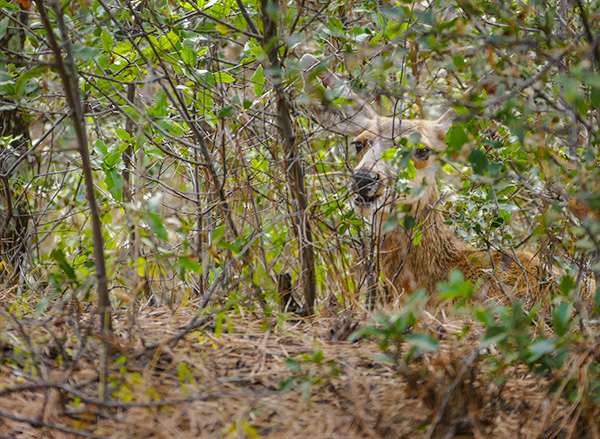
Nature’s camo! If I hadn’t had the camera set to a shallow Depth of Field that deer would be almost invisible.
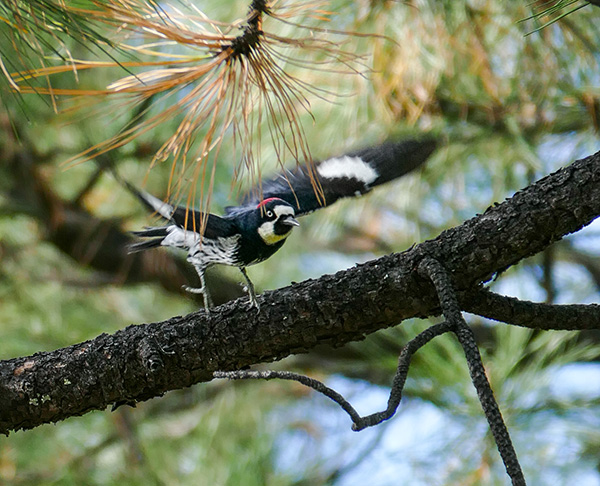
These woodpecker were flitting from tree to tree in search of their next snack. Having a high perch on an upper deck made photographing them relatively easy. The 400mm reach of the lens didn’t hurt either.
Don’t forget to take your cameras with you on holiday. It’s a great time to learn new settings that can help you get better images while not under any pressure…
Yours in Creative Photography, Bob
by successfulbob | photography, photography - art quote, photography education
Sometimes I head off on a tangent tapping into quotes from painters, writers, poets, coaches and others. Today let’s get back to a quote from a photographer. Former Magnum Photographer Wayne Miller documented war, black families and was a Life Magazine photographer among his other photographic endeavors.
A Time Magazine memorial article when 94 year old Miller passed away in 2013 started this way, “To photograph mankind and explain man to man — that was how legendary photographer Wayne Miller described his decades-long drive to document the myriad subjects gracing his work.”
Here’s the Photo Art Quote from Wayne that caught my attention.
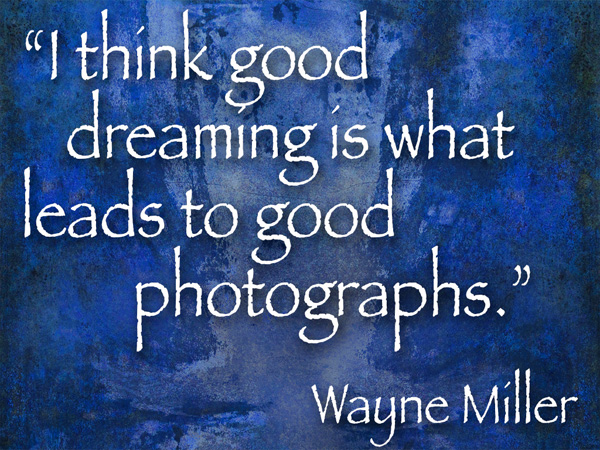
“I think good dreaming is what leads to good photographs.” Wayne Miller
Simple ten word thoughts like these lead me to do some searching to find a way to make my images stronger and a bit different from those that have created before me. I proudly say that i stand on the shoulders of those photographers that have come before me. Without them photography would not be what it is today. When you take strong ideas and then build upon them you come up with stronger images.
What is dreaming? According to Wikipedia, “Dreams are successions of images, ideas, emotions, and sensations that occur usually involuntarily in the mind during certain stages of sleep.” An idea to capitalize on your dreams is to work to retain them after the fact is to have a notebook and pen or recorder next to your bed. If you don’t jot down the ideas that come to you in dreams within a few moments of wakening they go out and become part of the ether again.
To my mind photographic dreaming is a culmination of all the information you place in front of your eyes. Movies, books, photographs, impressions from your travels and added to that your imagination mixing all of these elements together. This can also be done while you are awake to have more control. Give yourself permission to day-dream. I know it was probably knocked out of you at an early age with parents and teachers telling you to, “Stop woolgathering!” “Pay attention!” “Day-dreaming is a waste of time…” Now you don’t want to do it all the time, but you do want to let your mind wander and play. Playing is one of the best ways to learn and develop new ideas and concepts.
What do you dream about? Have you found ways to incorporate your dreams into your photography?
Yours in Creative Dreaming, Bob