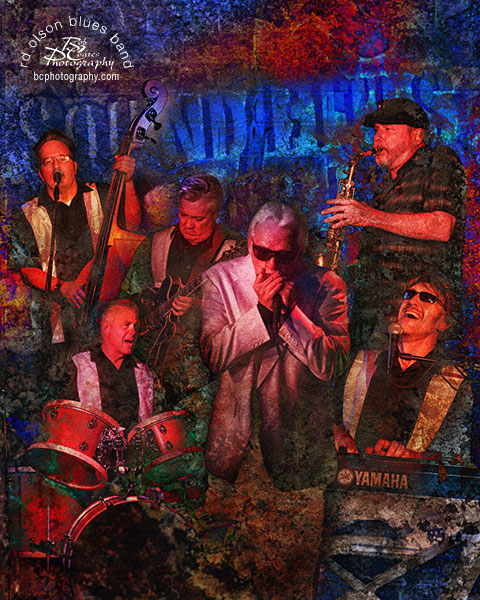
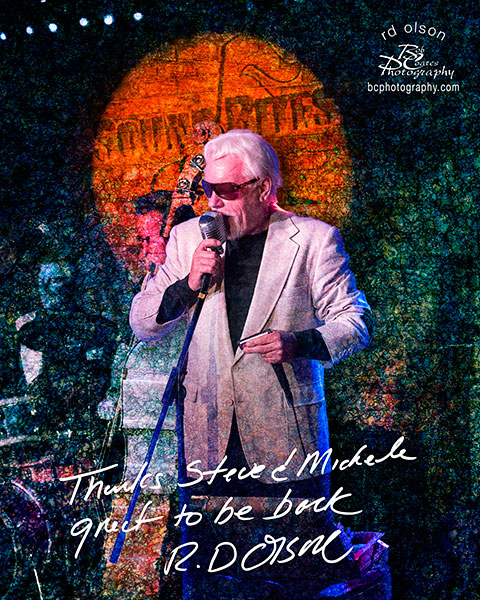
There are two new inductees into the Sound Bites Grill ‘Wall of Fame’.
The RD Olson Blues Band played last week and rocked (blued??) the house. High energy blues from this five piece band had people squirming in their chairs and out on the dance floor. My wife Holly and I really enjoyed the music along with the rest of the patrons.
R.D. Olson Blues Band
Images of the band members were captured with the Lumix GH4 and the 35-100mm Lumix Vario f2.8 lens. This camera and lens combo gives me the density range to capture the highlights of the LED lighting and the deep shadows that come with stage spotlights. In addition, the 200mm lens (35mm equivalent) allows me to isolate the individual performers without disturbing Sound Bites guests as I photograph the live performance.
After downloading the images I select each performer and move them to a master file for compositing of the group for the art piece. Shadows and Inner Glows using Adobe Photoshop on layers help to give the individuals depth in the image. Multiple photographs of textures are added and Blend Modes altered to add the color and painterly effects.
RD was also selected by Sound Bites to also be featured as a single artist in addition to being on the ‘Wall of Fame’ as part of the band.
Talking with Mike Tabback on KAZM Radio on the Tech Talk Show. We chat about some techniques in photography and some of the new tech that Panasonic is putting into the cameras. 4K Photo Mode is making some new image captures possible that would have been more difficult to photograph than even a few years ago.
My wife Holly calls it harrassing cause I used to have to get very close to the birds to fill the frame and they often would leave in a snit at being disturbed… I call it photography while I study and capture behavior images. I really enjoy photographing birds. At her parents place which looks over the marsh in Delaware I’ve plenty of subjects.
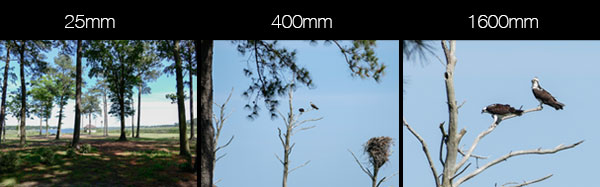
I was curious as to how the Lumix FZ1000 would perform and I gotta tell ya it ain’t bad at all. Having a 400mm f4.0 lens is quite good. I’m even more impressed with the ability of the digital zoom going to 1600mm. At that zoom range some detail it starts to soften but being able to fill the frame from a long distance is more than worth the trade-off. Here is a sequence to show the range of the camera…
Images made from the same position. To get to the digital zoom of 1600mm you must be in jpeg capture mode.
Still, with proper exposure I’ll take the reach over being able to shoot in RAW.
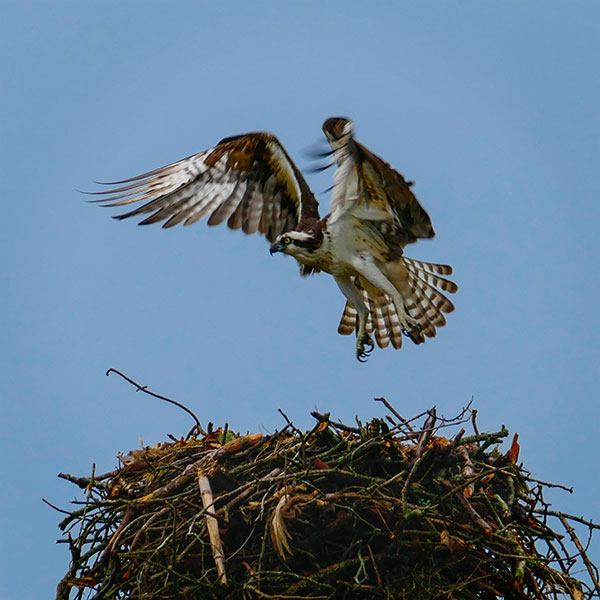
Osprey doing a flyby of her nest.
If I’m going to have one camera for vacation, or just to have at hand daily – that does almost everything I need – the Lumix FZ1000 is the one.
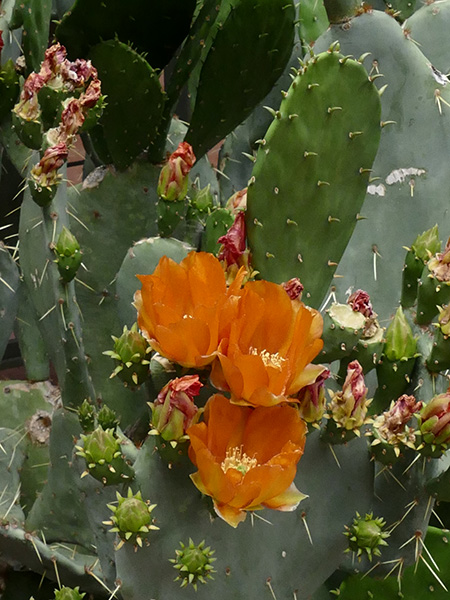
Walking from my favorite restaurant and I spy an absolutely beautiful flower bloom on a cactus. So I stop to shoot a couple frames and move on in the glow of the after dinner bliss… Or, was it the wine?
No matter.
‘Squirrel Moment!’
I know you’ve had this happen.
You think you see something beautiful. On the move you grab a frame thinking you have something to work on later. Turns out you were distracted by the ‘squirrel!’ in the image and failed to look at the whole scene carefully in the frame. Here’s a recent ‘squirrel’ shot from my wanderings.
Man, I almost don’t even want to show you this… In my mind I saw the flowering blooms
and new buds coming on (cue beautiful music)…
The reality of the ‘past prime’ dead flower buds escaped my notice until
I opened the image and viewed it on the computer. “Bummer!”
I think it’s good to share the not so good stuff as well as our treasures so we all know we are in the same boat… Chugging away, trying to create beautiful images, and not always hitting a home run. The usual camera was in play and it did a good job helping me get a nice exposure on the run. It’s not the fault of the Lumix FZ1000 that I can be distracted by a ‘Squirrel Moment”… They can’t all be perfect can they???
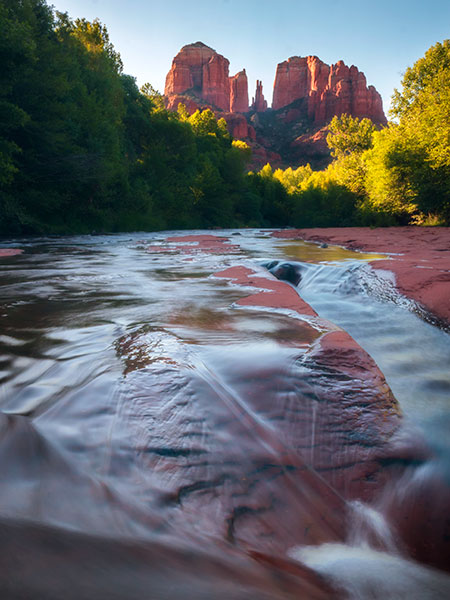
Up early as dawn was breaking I had my tripod set up in the bed of Oak Creek in Sedona, AZ. In the distance was water’s opposite – the stoic red rock formation of Cathedral Rock. I wanted to have the water slow flowing and that required a longer shutter speed than I was able to obtain with just the camera settings… Neutral density filters to the rescue.
Cathedral Rock on Oak Creek in Sedona, AZ. One of the top ten most photographed places in the country.
In the image above I used a 4 stop ND filter in the holder and added a 2 stop graduated ND filter at an angle across the top right hand corner where the sun was streaking across the trees.
Chris Kalmbach, one of the members in my Cohort in the new educational platform called the Arcanum, has been creating beautiful imagery using some long exposures using neutral density filters. Seeing and critiquing his images made me want to play with ND filters again.
I personally didn’t want to invest a boatload of money into filters I might only use a few times so I did some poking around and found these very inexpensive plastic filters with a full range of step rings, holders, lens shades and more from Neewer. See the ND Filter kit Here.
Yours in Creative Photography, Bob
PS – Enjoyed this water quote… “My fake plants died because I did not pretend to water them.” Mitch Hedberg
“When you take a flower in your hand and really look at it, it’s your world for the moment. I want to give that world to someone else. Most people in the city rush around so, they have no time to look at a flower. I want them to see it whether they want to or not.” Georgia O’Keeffe
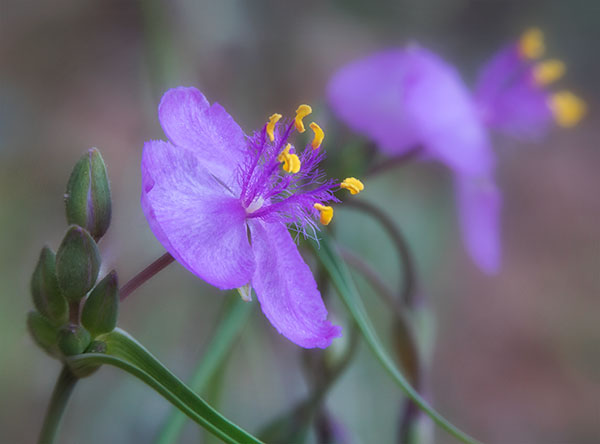
In the desert southwest the smallest of flowers dot the landscape at certain times of year. I agree with Georgia that sharing the world that many pass by is a cool thing… These particular flowers can easily go by unnoticed because of tiny size. These flowers are about the size of my thumbnail.
Tiny desert flower bloom
To capture a flower this size takes a little thought and manipulation. This was captured with the Lumix GH4 and 35-100mm 2.8 Vario lens with 26 mm of extension tubes from Neewer Technologies (get two sets they are very inexpensive and you can magnify even more using the technique below). When you have that much extension Depth of Field is extremely shallow. In order to get the buds and the first flower in total focus to share the miniscule detail I added a tripod and the technique of focus stacking. I focused on the bud in the foreground and made an exposure, changed focus to the bud a little further into the image followed by multiple captures across the surface of the flower. These exposures were taken into Adobe Photoshop and blended together using Photo Merge. When this process is used Photoshop will stack the images and blend together the sharpest parts of the image giving an increased DOF.
For infrared conversion of my cameras I use LifePixel. Infrared allows you to put an older camera to use and opens up a new time time of day for productive image creation.
Learn Photoshop in a fun environment. Aaron Nace applies the right amount of fun with easy to understand and follow tutorials. Actions and brushes are included with lessons!
Best embroidery ever. Give Queensboro a try, get a $20 instant credit to get started by clicking on the logo! They specialize in great quality custom logo apparel and promotional products with the best customer service.
Platypod has become a great resource for being creative in getting your camera gear easily into unusual places. As an Platypod Pro I get to work/play with the gear even before it comes out. Head over to Platypod, subscribe to the newsletter and you will get special discounts reserved only for subscribers.