“The… event occurred around the first serious choice I made as a photographer to concentrate on a limited subject. The subject was always light, but I wanted to explore a single form, which turned out to be the flow of water in creeks and rivers near my home. I photographed in every season, when the water was high in February and March, when it was low in August, when it was transparent in July, when it was an opaque jade in December. In 1980 I began to photograph moving water in moonlight, exposures of twenty-five or thirty minutes. These images suffered from reciprocity failure – the color balance in them collapsed – but they also recorded something extraordinary, a pattern of flow we cannot actually see. They revealed the organizing principle logicians would one day call a strange attractor.
The streaming of water around a rock is one of the most complex motions of which human beings are aware. The change from a laminar, more or less uniform flow to turbulent flow around a single rock is so abstruse a transition mathematically that even the most sophisticated Cray computer cannot make it through to a satisfactory description.
Aesthetically, of course, no such difficulty exists. The eye dotes on the shift, delights in the scintillating sheeting, the roll-off of light around a rock, like hair responding to the stroke of a brush. Sometimes I photographed the flow of water in sunshine at 1/2000 of a second and then later I’d photograph the same rock in moonlight. Putting the photos side by side, I could see something hidden beneath the dazzle of the high-speed image that compared with our renderings of the Milky Way from space: the random pin-dot infernos of our own and every other sun form a spiraling, geometrical shape motionless to our eyes. In the moonlit photographs, the stray streaks from errant water splashes were eliminated (in light that weak, they occur too quickly to be recorded); what was etched on the film instead were orderly, fundamental lines of flow, created by particle after illuminated particle of gleaming water, as if each were a tracer bullet.
(Years later, reading Chaos, James Gleick’s lucid report on chaos theory, I would sit bolt upright in my chair. What I’d photographed was the deep pattern in turbulence, the clothing, as it were, of the strange attractor.) “
– Barry Lopez, “Learning to See,” chapter 13 in About This Life
In a post a couple days ago I talked about an art installation at the Scottsdale Museum of Contemporary Arts and how it moved me and made me sad…
Well, there was another installation there that saved me from spiraling too far down into the depths. It was Bruce Munro’s Ferryman’s Crossing.
When I first walked in to the Crossing I thought, “WTH??? It’s a bunch of CD’s on the floor…
First look at Ferryman’s Crossing
And despite my initial reaction I decided to spend some time checking it out. Glad I did.
The CD’s are tilted in two directions with lights flashing down from the ceiling from different angles, timings and places. This is not an environment you want to be in if you are epileptic but strangely enough it is a very calming place to be. There are large expanses of concrete receiving the reflections bounced off of the cleverly placed CD’s.
Sounds of a stream with birdsong and wildlife are piped in while the reflected lights play as a dance upon the walls. The longer you stay in the art the more you see. Yes I said in the art. You can walk as though on the banks of the stream. As in Joseph’s Coat from the bible many colors appear among the CD’s while the soft reflections play upon the walls.
Here’s a short video to give you a feel for the movement within the art.
Maybe it’s because I consider myself a ‘child of the water’ and enjoy all kinds of water I felt more at home here the longer I inhabited the space.
I did think to try and push the envelope of my creativity to see what I might capture with my camera. So in addition to the ‘straight’ images I photographed here are a few from my experimental foray. I looked for slightly different images to tell the story of this art piece.
Zooming the lens slightly during capture led to the electric colors and patterns
Rotating the lens and moving during capture…
Images were captured with the Lumix LX100 camera. To make the colors appear richer I set an underexposure of approximately 2 stops. Slight processing and enhancing with Adobe Camera Raw using the highlight and shadow sliders…
Sometimes we need to spend time in a place before it begins to share it’s innermost secrets with us.
Writing this Photo Art Quote post for the blog used to be a bit of a chore… But I find more and more, this time of thinking about art and how it works for our business, and health, and state of mind for creating has been quite interesting. It has forced me to think about the creation process in all areas of art, not just photography. How all artists including photographers become and stay creative.
Which brings us to today’s conversation. The quote is from New York writer Michael Kaninwho won an Academy Award for Best Screenplay and wrote comedy material for comics, actors and movies. Obviously successful but seems to have found the day-to-day part of the job a chore…
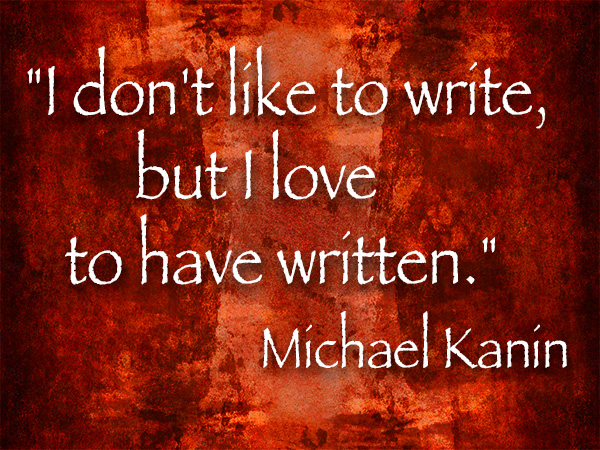
“I don’t like to write, but I love to have written.” Michael Kanin
This quote caught my attention because there are times when working on a photo project I just want to toss it out and go on to something new. It usually turns out that these become the finished images that show the most depth and of which I am most proud to have completed. Don’t get me wrong. I love photography! But there are occasions when the work that’s necessary to bring a project to fruition seems like it will go on forever. Of course, there are times when you have yo know when to quit when enough is enough. But when is that?
Our society has become a ‘I want it now!’ creature. Things come to us at the speed of the Internet. (which is really, really FAST! A search on the word ‘photography’ gave this result – About 979,000,000 results (0.66 seconds) ) We have access to more information than ever before and I find that to be a blessing and a curse. A blessing because the access to material and the ability to learn new things is incredible and I embrace it. And, I believe it to be a curse for the exact same reason. It can be difficult to concentrate on a single project when so many ideas are clamoring for attention.
Digital has made it easier than ever to create. The question becomes is it just ‘good enough’ and it’s time to move on? Or can we delve deeper to create something of more lasting value?
I suppose it’s a question for the ages and one we should probably revisit with regularity.
So do you labor enough to take your images to the next level? Or is an image ‘good enough’?
It’s pretty amazing how far the new HDR software from Macphun called AuroraHDR has come. Layers are now available within. An interface that’s pretty straightforward but with lots of control available in many different areas of manipulation.
One of the things I find I really like is the ability to get the most out of the dynamic range in the scene… and still have a very realistic image rather than one that screams HDR!!!!! And, even better presets that will get you close to the final look you want.
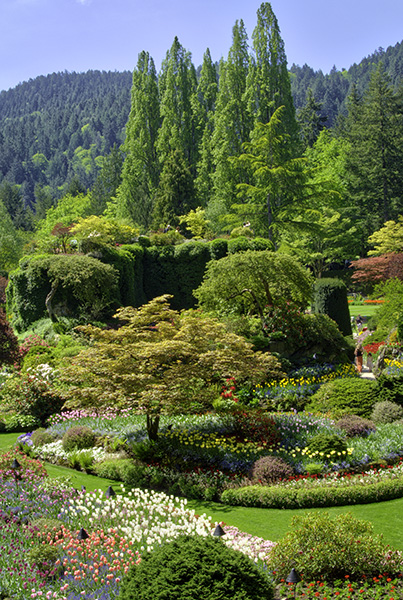
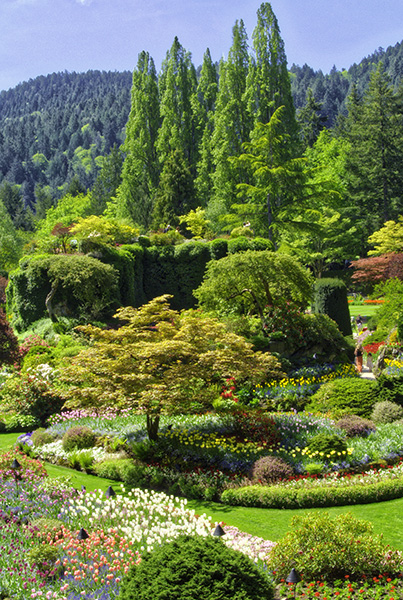
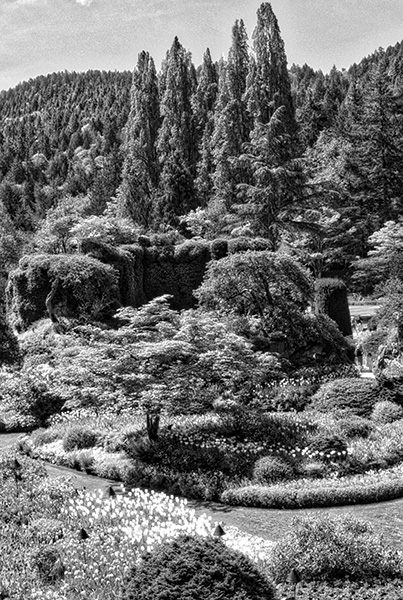
I pulled a set of three images from Butchart Gardens in Victoria British Columbia near Vancouver, Canada and thought I’d see how the software worked with these older files from the Leica D-Lux 4 point and shoot camera.
Natural preset.
A bit more ‘tooth’ in this preset. I like what it did to the greenery but not so much the sky. Could be combined with the image above or processed with layers in Aurora to clean up sky area.
Black and white preset… Not bad. No extra processing.
You can be as subtle or as outrageous in your processing as you would like. Shooting multiple images to expand your density range? Try out the program. I think you’ll like it.
Yours in creative Photography, Bob
PS – Get some extra goodies if you buy before February is over 99 bucks for the program and 90 bucks in bonuses. And always a 30 day money back guarantee… Click on the banner for more info.
Down in Scottsdale yesterday to meet up with some photographers and deliver a family portrait. I stopped by the Scottsdale Museum of Contemporary Art and was reminded of how powerful art can be. I had no idea what was on display but just thought I’d get a quick lift.
Wow! A different experience awaited me within those walls.
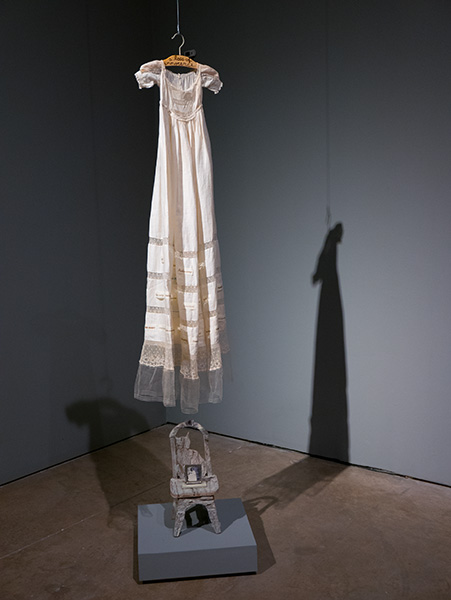
Betye Sarr has been creating art about the black experience in the United States for over 60 years. And it was a poignant reminder of how terrible we were as a people. Even to having a constant ‘put in your place’ language that started with children. One piece especially moved me deep to the core.
It was very simple.
A dress hanging from the ceiling.
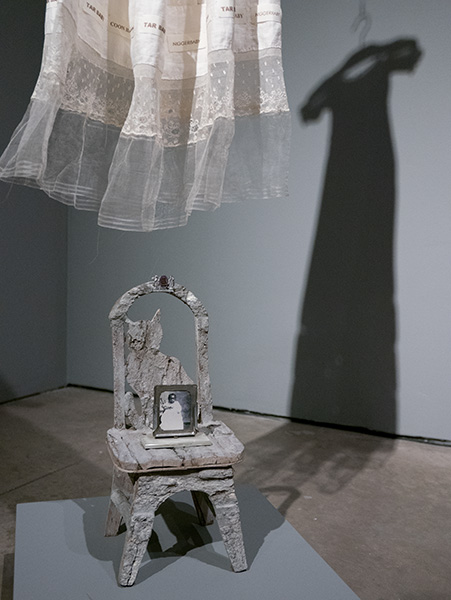
Hemmed with offending words suspended above a small child’s chair with a small framed portrait of a black child.
Two spotlights.
A corner.
‘A loss of innocence.’
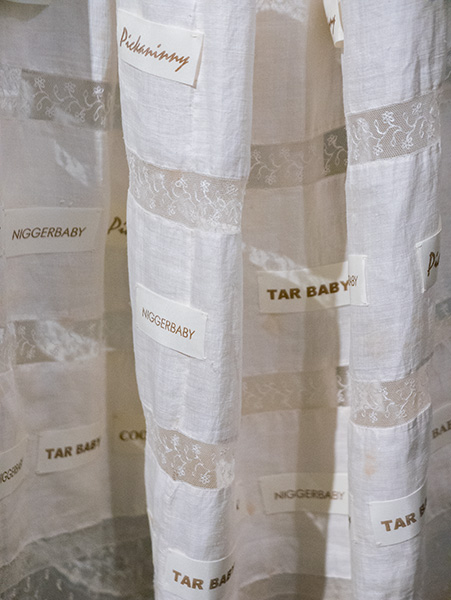
Detail
From ‘Loss of Innocence’ Dress detail showing the repetitive words hemmed into the dress – Tar Baby, Niggerbaby and Pickaninny.
I was moved.
From the SMOCA Description of Betye’s Show
There is a touch of alchemy to Betye Saar’s artwork: transforming the simple and mundane into powerful art. Since the 1960s, her compelling, astute and expressive works reflect on African- American identity, spirituality and the inter-connectedness between different cultures. This timely retrospective brings together recent work as well as historical pieces created over her six decade long career… more
I wonder if I will ever be able to create art that moves people as much as this installation moved me.I think we as photographers can find inspiration from many different places..
How about you? Where do you find inspiration??
Yours in Creative Photography, Bob
PS – images were captured with the Lumix LX100. I call this sweet little camera the ‘Pro’s point & shoot’. Solid magnesium body, all necessary exposure controls available on the outside on click stop dials. 24-75mm f1.7-f2.8 Leica lens.
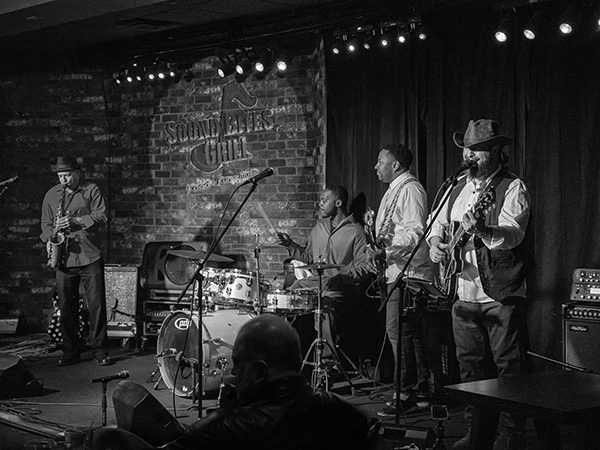
Take an electric guitar. Acoustic guitar. A bass guitar. A small sax… and a large one. Throw in someone who knows how to play the drums. Add in a voice that is pure magic and the namesake of the band. And what do you get?
A really good time listening to Southern Soul!
What is SOUTHERN SOUL? A sweet blend of blues/gospel/americana/r&b with a splash a cayenne pepper.
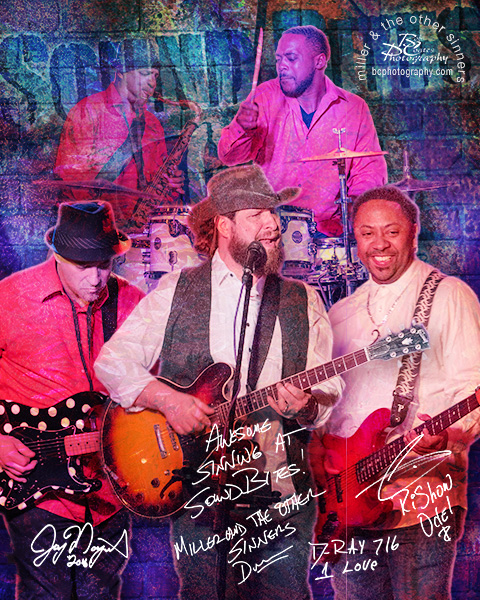
Saturday night Miller and the Other Sinners performed at Sound Bites Grill and I had the fun job of photographing them for the ‘SBG Wall of Fame’. This group really rocked the house with a bluesy sound that had everyone bouncing in their seats.
Sound Bites Grill Wall of Fame image for Miller and the Other Sinners
I used two cameras for the event.
I used the Lumix GH4 with a 35-100mm Vario f2.8 lens for the individual band member captures. I generally shoot at ISO 3200 in aperture priority with a minus 2/3rds of a stop exposure compensation in RAW. This will generally get me an exposure between 1/60th & 1/100 of a second. Taking the images into Adobe Camera Raw with just a little push up of the shadows slider and a reduction of the highlights I am able to get the entire dynamic range of the scene.
The second camera is the Lumix GX8 with a wide f2.8 12-35mm Vario zoom. These images are of the whole band and used for press releases and marketing. Same basic settings on the camera. A great feature of shooting with these cameras is the Live View function as you are seeing the image as it is being captured so it’s easy to make tweaks to the settings before firing the shutter.
Marketing images are created in color but I specifically do the BW conversion myself so the best quality will be printed rather than someone at the publication just pushing the greyscale button. NIK Silver FX Pro 2 is the go-to software plug-in.
Knowing how the images are going to be used dictates how images are processed. I always try to create the best image file for the job at hand. Remember to ask questions in order to be able to provide the best product.
For infrared conversion of my cameras I use LifePixel. Infrared allows you to put an older camera to use and opens up a new time time of day for productive image creation.
Learn Photoshop in a fun environment. Aaron Nace applies the right amount of fun with easy to understand and follow tutorials. Actions and brushes are included with lessons!
Best embroidery ever. Give Queensboro a try, get a $20 instant credit to get started by clicking on the logo! They specialize in great quality custom logo apparel and promotional products with the best customer service.
Platypod has become a great resource for being creative in getting your camera gear easily into unusual places. As an Platypod Pro I get to work/play with the gear even before it comes out. Head over to Platypod, subscribe to the newsletter and you will get special discounts reserved only for subscribers.

 Barry Lopez book About This Life – Journeys on the Threshold of Memory