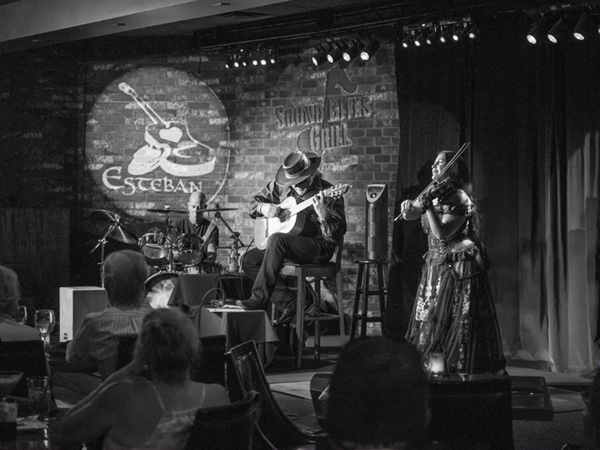
There’s a new rendition of Esteban and company on the Wall of Fame at Sound Bites Grill in Sedona. It was time to get drummer Joe Morris in place as he’s been playing for the last two years. Some great music at the bottom of this post. You might want to click play on that as you read the rest of the info.
Esteban – Teresa Joy and drummer Joe Morris
Here’s the rundown on the creation of art for the SBG Wall of Fame. I start with images of the musicians captured during live performances. They are individually extracted from the scene and then reassembled into the final composition.
In Adobe Photoshop the pieces are composited while adding layers of texture in various Blend Modes. Drop Shadows add depth. The Inner Glow Mode is used to create lighting effects. Artists are asked to add messages and autographs in black Sharpie Marker. These are inverted and added to the image as it would be almost impossible to track down people after they have completed their gig.
My cameras of choice are either the Lumix GH4 or the GX8. Both cameras have the density range and frame rate to handle the LED stage lighting which can be tough as there is only pure color in the lights. My primary lens choice for getting the individual photos is the 35-100mm f2.8 Vario. The lens is equivalent to a 70-200mm full frame.
Full stage at Sound Bites
For the entire group and stage publicity photos, I use the 12-35mm f2.8 Lumix Vario lens. It’s a solid wide angle zoom that teams up well with the 35-100mm.
Esteban – La Paloma Classical Guitar with Teresa Joy on violin
I have been fortunate to live in places with some spectacular scenery and would probably have a hard time living in an urban environment or someplace dull and flat. Sedona, Arizona is the gorgeous place I now get to call home. Red rock vistas and a dry climate that showers us with sunshine two hundred seventy-eight to three hundred days per year.
And, after residing here seventeen years, I still find different ways to view the majestic red rocks thanks to visitors spurring me on. Some visiting friends asked if a helicopter tour would be worth a go and would I be interested in joining them? I said, “Yes indeed!” I was surprised I hadn’t thought to fly the skies with my camera in all that time.
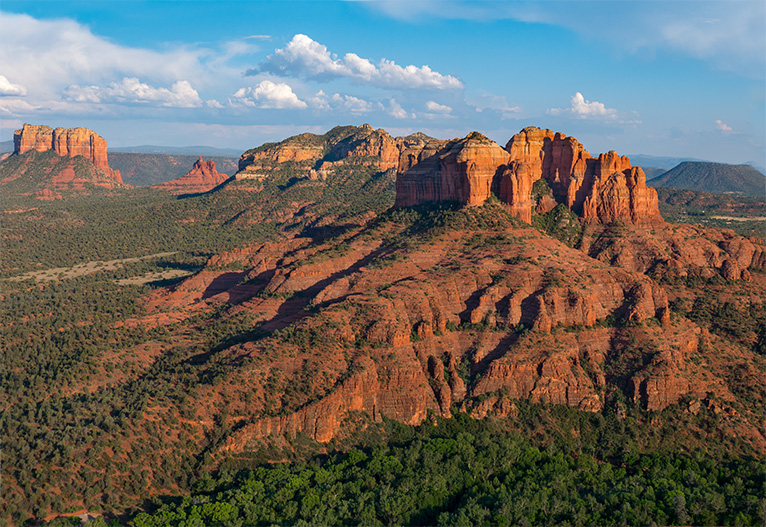
Sedona’s famous Cathedral Rock from the air. Lumix G7 with 12-35 f2.8 Vario G lens @f5.6 1/400 sec. 12mm (24mm FF equivalent) ISO 200
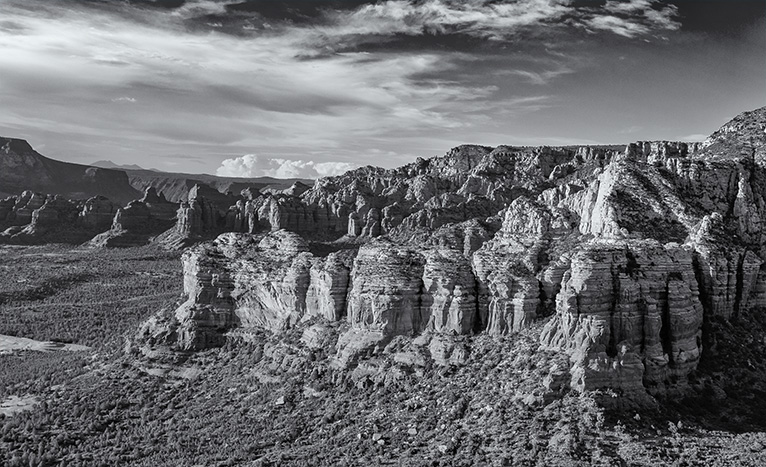
More Red Rock formations. Same gear as above. @5.0 1/400th sec, 19mm (38mm FF equivalent)
Processed in NIK Silver FX Pro2 (available free from Google)
Cathedral Rock is one of the state’s most photographed destinations. I know that I have photographed it on numerous occasions, but never from the air. An artistic rendition of Cathedral Rock was one of my first Merit images in Professional Photographers of America image competition.
Let’s talk about photographing from the air.
I have done photography in the past from the air, but it was always a charter flight where I was calling the shots for the position of the helicopter or plane and the possibility of staying on station or revisiting until I had the shot. With that kind of luxury, there was time to check settings of the camera ensuring they were correct. This flight was going to be a horse of a different color. A sightseeing tour lasting 17 minutes and no do-overs.
I thought about the new technology I have access to in the Lumix cameras and decided to place my trust in it. I’ve talked about this setting once or twice before. It’s called Intelligent Auto. I jokingly refer to it as the ‘Honey, stop the car!’ setting. It calculates the f-stop, shutter speed, and ISO. I have always used it sparingly as I want to make the decisions that control the final look of the image. In this case with no time to devote to changing settings I decided I would concentrate on framing and composition and see how well the camera would do. Shot in RAW to have more latitude to cover exposure but the SOOC files were pretty darn good.
After looking at the metadata for exposure settings (see above) I was surprised to note that the camera had automatically recognized the scene as a landscape and set the camera for ‘Landscape Mode’ – “For landscape photos with background in focus.”
Once again I was pleasantly surprised. Shutter speed was high enough to freeze the scene in spite of the helicopter’s vibration and motion. Exposure was solid for the scene. All-in-all it’s a winner. If this were a commercial shoot for a paying client, I would be working this entirely different but this is a great help in quickly changing situations.
Thinking about visiting Sedona? Check out http://www.sedonaairtours.com for your aerial view of the red rocks. really enjoyed my experience with Sedona Air Tours. They work together as a great team!
Learn more about other attractions in Sedona at theVisit Sedona website.
(You might want to scroll down to play the 1967 hit from the Fifth Dimension called Up, Up and Away while you read the rest of this post.)
Imagine floating in Silence. Beautiful red rock vistas spread before you like towering sculptures.
That was the first thing that came to mind as a surprise when I took a balloon flight over the red rocks of Sedona. Silence only interrupted by the occasional roar of the propane burner to control our height above terra firma. Silence only changed by the occasional comment of a fellow passenger exclaiming about some new deer or rabbit that came into view unaware we were hovering overhead. Gliding over the landscape is an incredible way to experience Sedona.
You can’t beat it with a stick!
I was out on a photo ‘dawn patrol’ with my cameras and fellow Lumix Luminary photographers Suzette Allen & Jon Yoshinaga while they were in town for a visit. We set up for sunrise over the valley and were gifted with the lifting of the hot air balloons. It is always a fun addition to a shoot when the hot air monoliths pass through the scene as a colorful counterpoint to the scenery.
Here are a couple of the photos I captured of visitors heading off to a sky adventure.
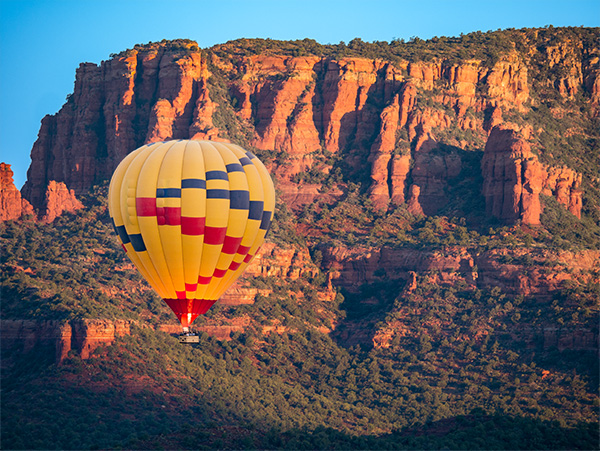
Hot Air Balloon lifts off into the azure blue skies over the red rocks of Sedona. Captured with Lumix G7 with 100-300mm f4.0-5.6 Vario lens @f4.9 1/160th sec 193mm (386mm FF equivalent) ISO200
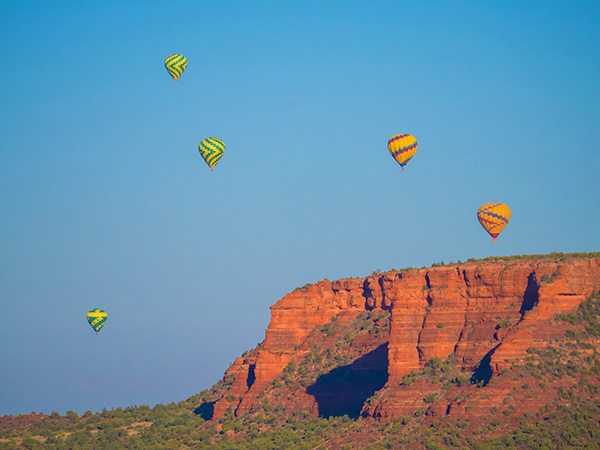
Balloons dot the skies above the Red Rocks. Lumix GX8 with 100-300mm f4.0-5.6 Vario lens @f4.5 1/10000th sec 150mm (300mm FF equivalent) ISO800
If you asked the question above you probably were not a black and white film photographer from past days. We usually learned about the reticulation effects when we treated our film badly by either getting it too hot, processing it at the wrong temperature or some other variable I can’t remember now.
But, after seeing the effects, I remember trying to screw up the film for art purposes. I came across the look when I was messing about (read that playing) in Photoshop.
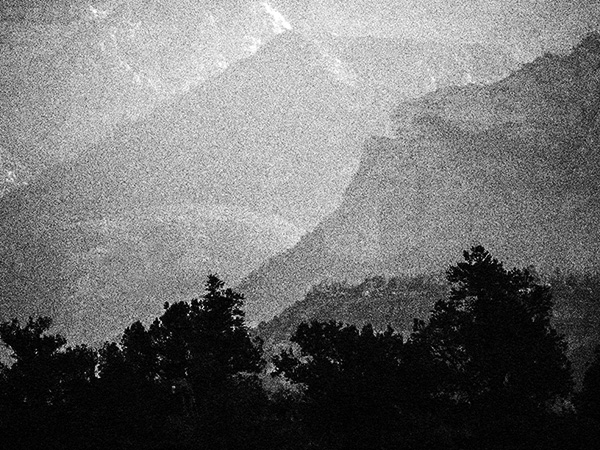
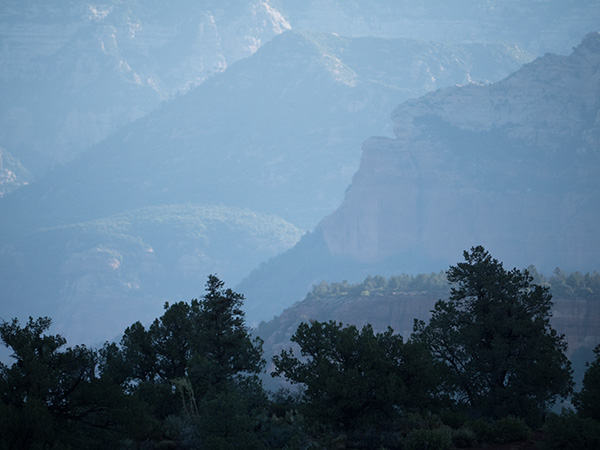
Photographed around sunrise with haze in the distance. Straight out of camera (SOOC) Lumix GX8 with Lumix G Vario 100-300mm f4.0-5.6 lens @ f5.6 1/1250 sec ISO 800 @ 300mm (600mm equivalent)
I choose this lens to compress the scene.
After processing.
I had made a set of images one morning near dawn, and I was feeling a bit of a ‘Japanese aesthetic’ in what I saw through the viewfinder. Things like that can happen when you are out shooting thinking you are getting one thing then, being a bit disappointed upon return to the studio process the files. I still felt I had something worth which to work. I liked the distance imparted by the haze that we don’t usually see in the high desert due to the dry air. This particular haze was thanks to some forest fires sharing some smoke with us.
After trying various filters, I stumbled on a look that reminded me of the reticulation of old. I pushed for it some more, and you see what I got above.
Not sure I’m where I want to be with this set of images. I’m going to put them away for a little while then revisit at a future time. Sometimes you need to try something out and come back later to see how you feel about it. There are a lot of compositions involving this same scene. Who knows? These files may be a treasure trove with this processing or some other treatment.
Or, it could just be a pile of… We’ll find out later.
Something old could be new again. Reticulation anyone??
Ernst Haas was born in Vienna in 1921. His early photographic work on Austrian returning prisoners of war brought him to the attention of LIFE magazine. Offered a job as a staff photographer he declined to keep his independence. At the invitation of Robert Capa, Haas joined Magnum Photographers in 1949, developing close associations with Capa and Henri Cartier-Bresson.
Experimenting with Kodachrome film. In 1953 LIFE magazine published a groundbreaking 24-page color photo New York City essay. This was the first time such a large color photo feature was published by LIFE. A 1962 retrospective was the first color photography exhibition held at New York’s Museum of Modern Art.
Needless to say, words of wisdom coming from an early icon have a bit of meaning son on to today’s Photo/Art Quote.
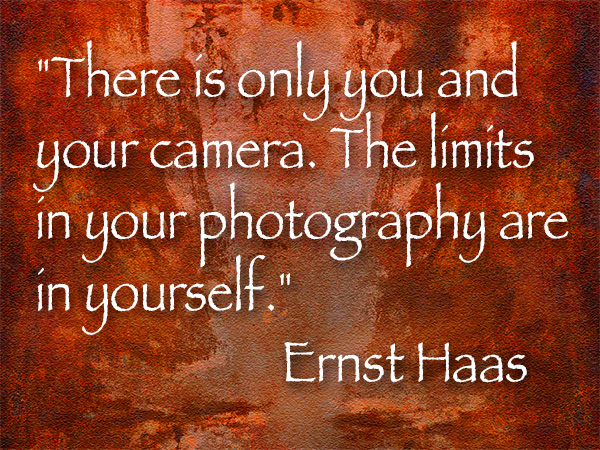
“There is only you and your camera. The limits in your photography are in yourself.” Ernst Haas
I believe these few words hold one of the secrets to becoming a better photographer. We need to look inside and learn what we want to create and how to do it. It goes back to something we talk about here in the Successful-Photographer blog, experimentation, and practice.
We also need to be forgiving of ourselves when we aren’t able to create the vision we have inside. Not having forgiveness leads to fear. Fear leads to lack of trying new things because we might not have success right away.
Lose the fear.
Experiment with new ideas and techniques.
Practice the new. Discard the old.
Learn your camera and its capabilities.
Look inside see what you can find to lose your limits.
For infrared conversion of my cameras I use LifePixel. Infrared allows you to put an older camera to use and opens up a new time time of day for productive image creation.
Learn Photoshop in a fun environment. Aaron Nace applies the right amount of fun with easy to understand and follow tutorials. Actions and brushes are included with lessons!
Best embroidery ever. Give Queensboro a try, get a $20 instant credit to get started by clicking on the logo! They specialize in great quality custom logo apparel and promotional products with the best customer service.
Platypod has become a great resource for being creative in getting your camera gear easily into unusual places. As an Platypod Pro I get to work/play with the gear even before it comes out. Head over to Platypod, subscribe to the newsletter and you will get special discounts reserved only for subscribers.

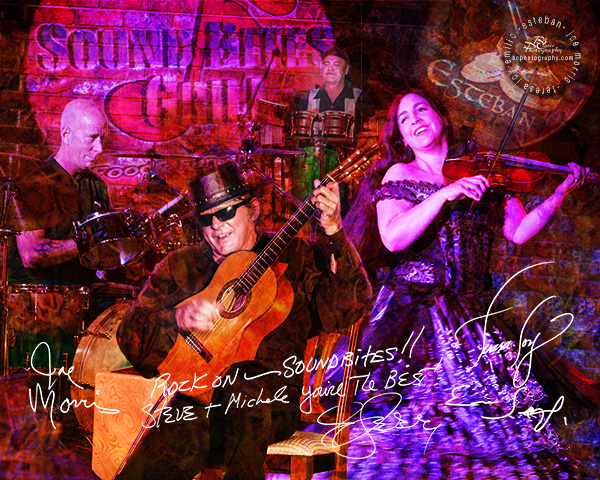
 Esteban – Teresa Joy and drummer Joe Morris
 Full stage at Sound Bites