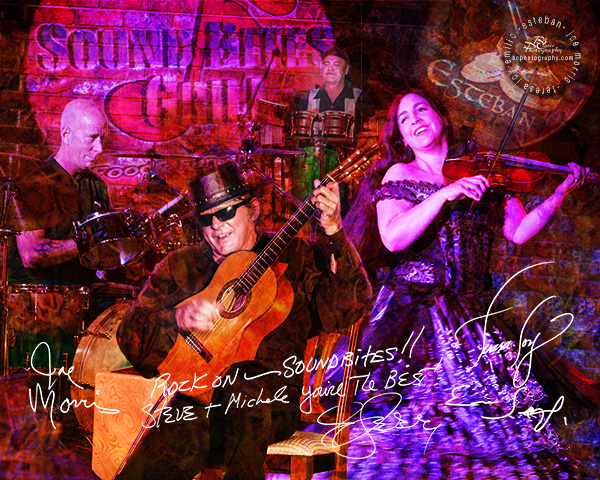
There’s a new rendition of Esteban and company on the Wall of Fame at Sound Bites Grill in Sedona. It was time to get drummer Joe Morris in place as he’s been playing for the last two years. Some great music at the bottom of this post. You might want to click play on that as you read the rest of the info.
Esteban – Teresa Joy and drummer Joe Morris
Here’s the rundown on the creation of art for the SBG Wall of Fame. I start with images of the musicians captured during live performances. They are individually extracted from the scene and then reassembled into the final composition.
In Adobe Photoshop the pieces are composited while adding layers of texture in various Blend Modes. Drop Shadows add depth. The Inner Glow Mode is used to create lighting effects. Artists are asked to add messages and autographs in black Sharpie Marker. These are inverted and added to the image as it would be almost impossible to track down people after they have completed their gig.
My cameras of choice are either the Lumix GH4 or the GX8. Both cameras have the density range and frame rate to handle the LED stage lighting which can be tough as there is only pure color in the lights. My primary lens choice for getting the individual photos is the 35-100mm f2.8 Vario. The lens is equivalent to a 70-200mm full frame.
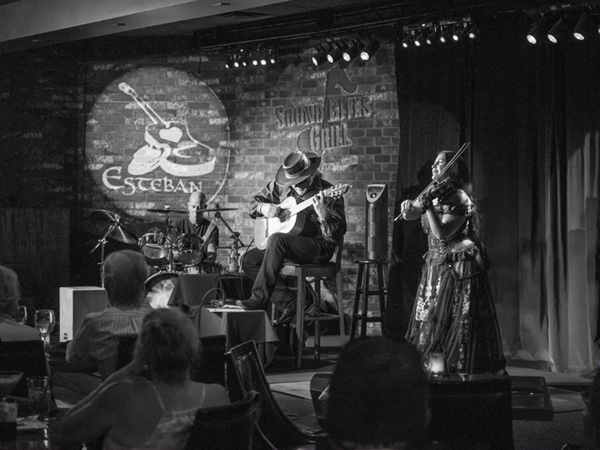
Full stage at Sound Bites
For the entire group and stage publicity photos, I use the 12-35mm f2.8 Lumix Vario lens. It’s a solid wide angle zoom that teams up well with the 35-100mm.
Esteban – La Paloma Classical Guitar with Teresa Joy on violin
I have been fortunate to live in places with some spectacular scenery and would probably have a hard time living in an urban environment or someplace dull and flat. Sedona, Arizona is the gorgeous place I now get to call home. Red rock vistas and a dry climate that showers us with sunshine two hundred seventy-eight to three hundred days per year.
And, after residing here seventeen years, I still find different ways to view the majestic red rocks thanks to visitors spurring me on. Some visiting friends asked if a helicopter tour would be worth a go and would I be interested in joining them? I said, “Yes indeed!” I was surprised I hadn’t thought to fly the skies with my camera in all that time.
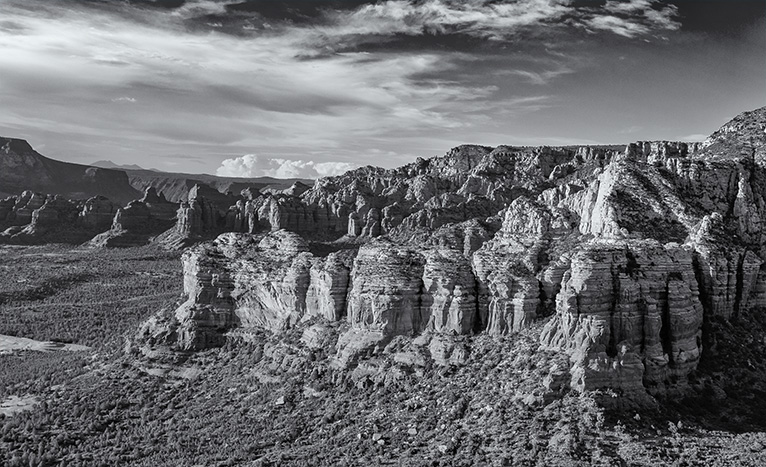
Sedona’s famous Cathedral Rock from the air. Lumix G7 with 12-35 f2.8 Vario G lens @f5.6 1/400 sec. 12mm (24mm FF equivalent) ISO 200
More Red Rock formations. Same gear as above. @5.0 1/400th sec, 19mm (38mm FF equivalent)
Processed in NIK Silver FX Pro2 (available free from Google)
Cathedral Rock is one of the state’s most photographed destinations. I know that I have photographed it on numerous occasions, but never from the air. An artistic rendition of Cathedral Rock was one of my first Merit images in Professional Photographers of America image competition.
Let’s talk about photographing from the air.
I have done photography in the past from the air, but it was always a charter flight where I was calling the shots for the position of the helicopter or plane and the possibility of staying on station or revisiting until I had the shot. With that kind of luxury, there was time to check settings of the camera ensuring they were correct. This flight was going to be a horse of a different color. A sightseeing tour lasting 17 minutes and no do-overs.
I thought about the new technology I have access to in the Lumix cameras and decided to place my trust in it. I’ve talked about this setting once or twice before. It’s called Intelligent Auto. I jokingly refer to it as the ‘Honey, stop the car!’ setting. It calculates the f-stop, shutter speed, and ISO. I have always used it sparingly as I want to make the decisions that control the final look of the image. In this case with no time to devote to changing settings I decided I would concentrate on framing and composition and see how well the camera would do. Shot in RAW to have more latitude to cover exposure but the SOOC files were pretty darn good.
After looking at the metadata for exposure settings (see above) I was surprised to note that the camera had automatically recognized the scene as a landscape and set the camera for ‘Landscape Mode’ – “For landscape photos with background in focus.”
Once again I was pleasantly surprised. Shutter speed was high enough to freeze the scene in spite of the helicopter’s vibration and motion. Exposure was solid for the scene. All-in-all it’s a winner. If this were a commercial shoot for a paying client, I would be working this entirely different but this is a great help in quickly changing situations.
Thinking about visiting Sedona? Check out http://www.sedonaairtours.com for your aerial view of the red rocks. really enjoyed my experience with Sedona Air Tours. They work together as a great team!
Learn more about other attractions in Sedona at theVisit Sedona website.
(You might want to scroll down to play the 1967 hit from the Fifth Dimension called Up, Up and Away while you read the rest of this post.)
Imagine floating in Silence. Beautiful red rock vistas spread before you like towering sculptures.
That was the first thing that came to mind as a surprise when I took a balloon flight over the red rocks of Sedona. Silence only interrupted by the occasional roar of the propane burner to control our height above terra firma. Silence only changed by the occasional comment of a fellow passenger exclaiming about some new deer or rabbit that came into view unaware we were hovering overhead. Gliding over the landscape is an incredible way to experience Sedona.
You can’t beat it with a stick!
I was out on a photo ‘dawn patrol’ with my cameras and fellow Lumix Luminary photographers Suzette Allen & Jon Yoshinaga while they were in town for a visit. We set up for sunrise over the valley and were gifted with the lifting of the hot air balloons. It is always a fun addition to a shoot when the hot air monoliths pass through the scene as a colorful counterpoint to the scenery.
Here are a couple of the photos I captured of visitors heading off to a sky adventure.
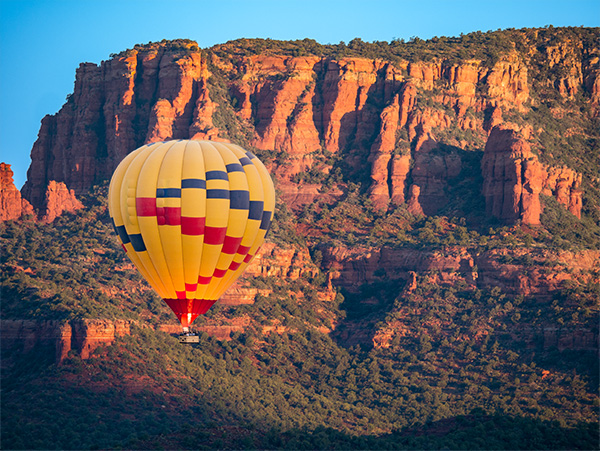
Hot Air Balloon lifts off into the azure blue skies over the red rocks of Sedona. Captured with Lumix G7 with 100-300mm f4.0-5.6 Vario lens @f4.9 1/160th sec 193mm (386mm FF equivalent) ISO200
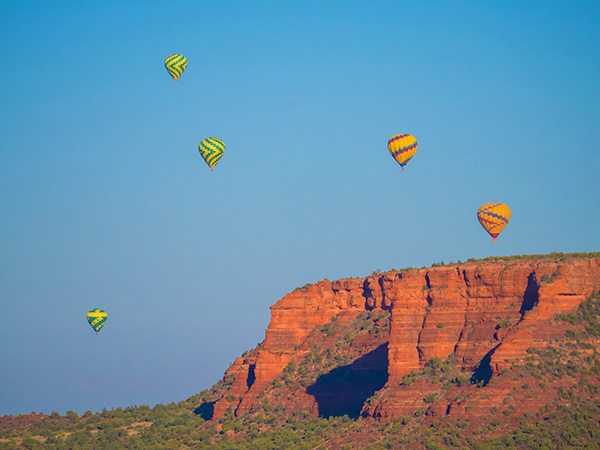
Balloons dot the skies above the Red Rocks. Lumix GX8 with 100-300mm f4.0-5.6 Vario lens @f4.5 1/10000th sec 150mm (300mm FF equivalent) ISO800
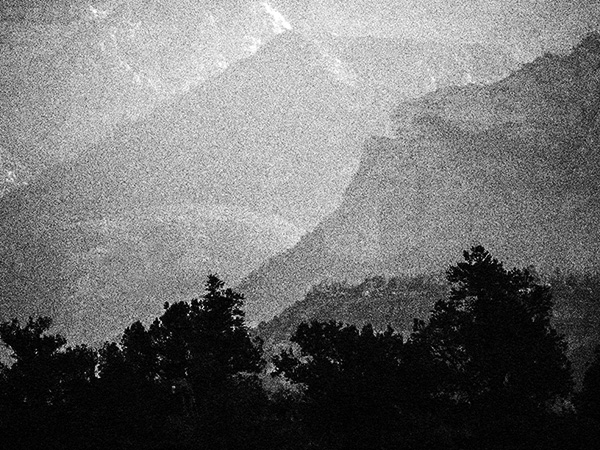
If you asked the question above you probably were not a black and white film photographer from past days. We usually learned about the reticulation effects when we treated our film badly by either getting it too hot, processing it at the wrong temperature or some other variable I can’t remember now.
But, after seeing the effects, I remember trying to screw up the film for art purposes. I came across the look when I was messing about (read that playing) in Photoshop.
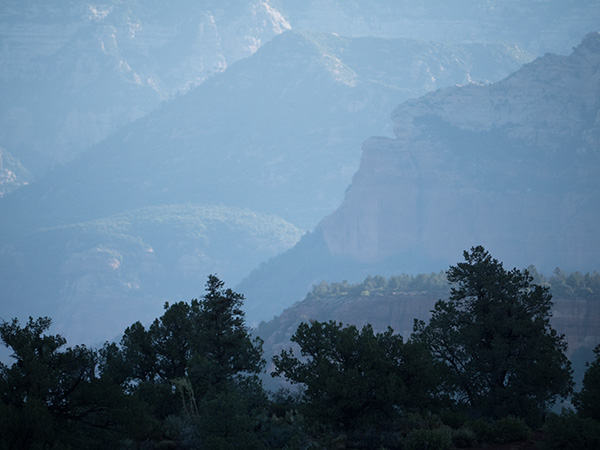
Photographed around sunrise with haze in the distance. Straight out of camera (SOOC) Lumix GX8 with Lumix G Vario 100-300mm f4.0-5.6 lens @ f5.6 1/1250 sec ISO 800 @ 300mm (600mm equivalent)
I choose this lens to compress the scene.
After processing.
I had made a set of images one morning near dawn, and I was feeling a bit of a ‘Japanese aesthetic’ in what I saw through the viewfinder. Things like that can happen when you are out shooting thinking you are getting one thing then, being a bit disappointed upon return to the studio process the files. I still felt I had something worth which to work. I liked the distance imparted by the haze that we don’t usually see in the high desert due to the dry air. This particular haze was thanks to some forest fires sharing some smoke with us.
After trying various filters, I stumbled on a look that reminded me of the reticulation of old. I pushed for it some more, and you see what I got above.
Not sure I’m where I want to be with this set of images. I’m going to put them away for a little while then revisit at a future time. Sometimes you need to try something out and come back later to see how you feel about it. There are a lot of compositions involving this same scene. Who knows? These files may be a treasure trove with this processing or some other treatment.
Or, it could just be a pile of… We’ll find out later.
Something old could be new again. Reticulation anyone??
Ernst Haas was born in Vienna in 1921. His early photographic work on Austrian returning prisoners of war brought him to the attention of LIFE magazine. Offered a job as a staff photographer he declined to keep his independence. At the invitation of Robert Capa, Haas joined Magnum Photographers in 1949, developing close associations with Capa and Henri Cartier-Bresson.
Experimenting with Kodachrome film. In 1953 LIFE magazine published a groundbreaking 24-page color photo New York City essay. This was the first time such a large color photo feature was published by LIFE. A 1962 retrospective was the first color photography exhibition held at New York’s Museum of Modern Art.
Needless to say, words of wisdom coming from an early icon have a bit of meaning son on to today’s Photo/Art Quote.
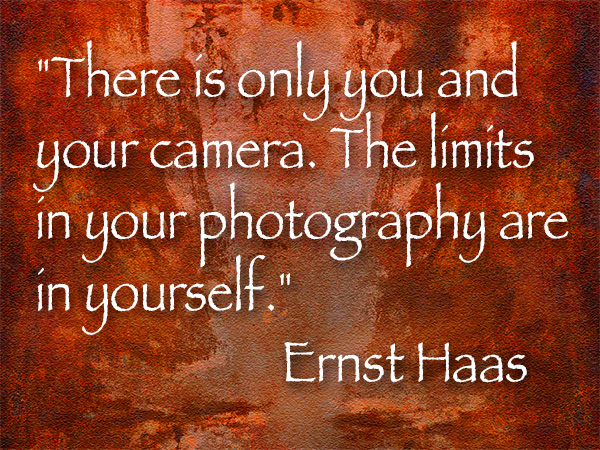
“There is only you and your camera. The limits in your photography are in yourself.” Ernst Haas
I believe these few words hold one of the secrets to becoming a better photographer. We need to look inside and learn what we want to create and how to do it. It goes back to something we talk about here in the Successful-Photographer blog, experimentation, and practice.
We also need to be forgiving of ourselves when we aren’t able to create the vision we have inside. Not having forgiveness leads to fear. Fear leads to lack of trying new things because we might not have success right away.
Lose the fear.
Experiment with new ideas and techniques.
Practice the new. Discard the old.
Learn your camera and its capabilities.
Look inside see what you can find to lose your limits.
Sometimes you just gotta change your thought pattern to get a better photo.
I was with fellow photographer Ralph Romaguera and his wife Cindy who were on a Route 66 road trip. They stopped by in Sedona as we are just down the road a piece for the Route 66 run. We shared a couple of meals and went out to shoot for a little while. Ralph has been using the Lumix GH4 and wanted to see if I had a few insider tips for best practices in using it. It turns out I could share a few ideas.
Today’s cameras from Panasonic are a bit more like computers with a lens than just a camera.
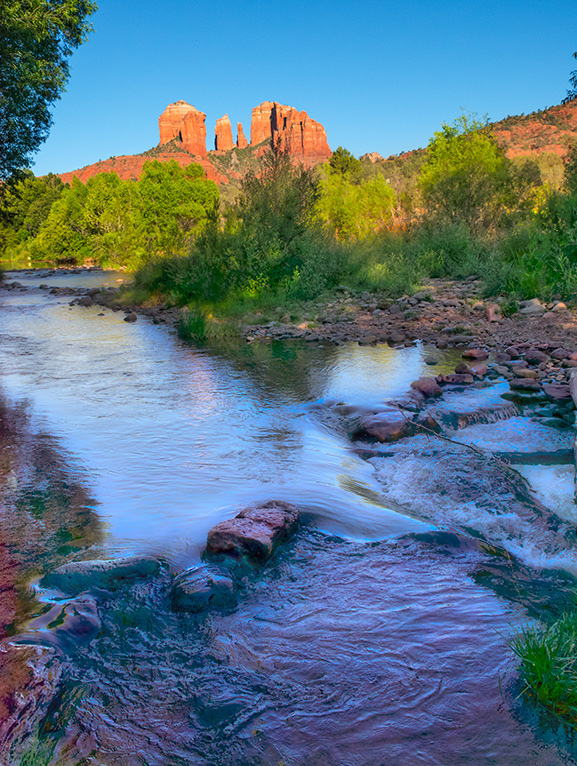
We talked about the ability of the camera to capture multiple exposures of a scene with just a quick twist of the dial. Many times, especially with landscapes, the dynamic range can be so large the only way to capture detail in the highlight and shadow areas is to use multiple exposures and blend them in post-production.
Multiple exposures were obtained to ensure proper detail in shadow areas as well as full sun. Images were processed in Aurora HDR software from MacPhun. Image captured with the GH4’s little brother the Lumix G7.
I usually don’t like how HDR blends skies into leaves or horizons as it tends to leave a bit of a halo. I process another image straight from Photoshop into the HDR software generated image to make the transition clean. Accomplished with an extra layer and layer mask.
Using the touch screen and choosing the exact position of your focus point is extremely handy. You can set the camera to a Mode called Intelligent Auto. With this setting, the camera sets the Aperture, Shutter Speed, and ISO. It provides an amazingly good solid exposure for the scene before it. Am I going to use that all the time? Heck no. But, I leave my cameras set to this mode when I am traveling around. I jokingly call it the ‘Honey, stop the car!’ Mode. It allows you to capture a scene instantly. Then, if the animal or whatever is still available, then I’ll move to one of the other modes to take more control of the final exposure.
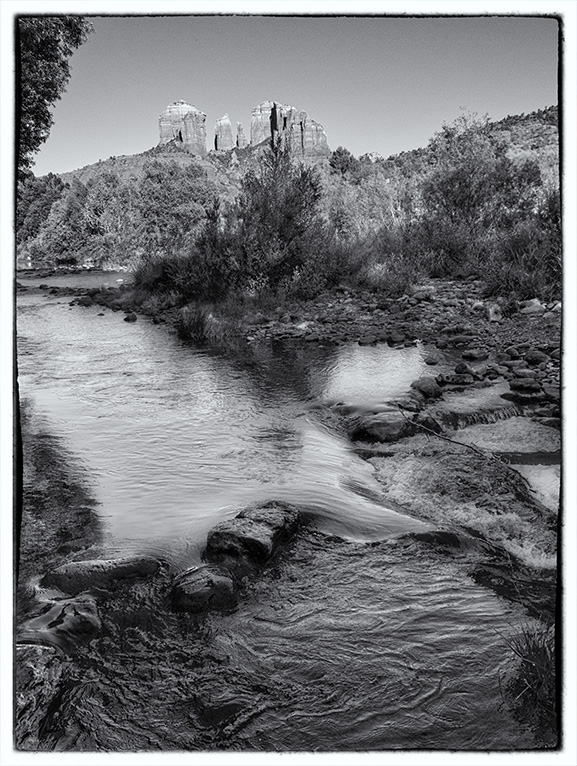
For an entirely different look here’s a black & white version converted in NIK Silver FX Pro 2 toned to selenium with a border added.
Al in all there’s a significant number of features to help you get the photo and/or video you are trying to capture in the GH4 and the G7. It nice to have photographers come from out of town for a visit that gives you a push to get out and shoot.
Yours in Creative Photography, Bob
“ The G7 makes an excellent camera for someone to grow into, offering all the key features a developing photographer would need access to. It offers some of the best tracking AF we’ve seen on any camera in this class. Video is the camera’s trump card, with the ability to capture high-res video giving all sorts of flexibility, whether you downsize back to 1080p, use it for selective cropping as you edit, or extract 4K stills of the decisive moment. ”
Ever found an image of yours being used without being paid for it?
I’ll bet you have. Whether it was a portrait client making prints from scans of your images or someone lifting a photograph from your website and using it without permission. Wait a minute, we all know as soon as you press the shutter button you own the copyright to the image, right? Right!
That’s true. But, professional photographers have long been left out of the copyright system. Legislation is underway for a Small Claims Process that will give photographers an equal seat at the copyright table!
Get the basic story in the video below.
Unless the infringement is more than $30,000 you won’t be able to defend your copyright in court.
And that sucks!
Professional Photographers of America has been on Capitol Hill lobbying legislators to help creators be able to have a small claims court option for protection of their work.
And now YOU can help! It’s easy but necessary for all creatives to get involved.
Join the Grassroots team to be part of getting the legislation passed. http://ppa.com/grassroots
You do not have to be a PPA member, or even a photographer, to be part of this copyright protection for ALL visual artists. Sign in to see how you can help. It won’t take much of your time. Encourage all of your photographer and artist friends to be part of this historic legislation. There probably won’t be a chance like this again in our lifetime. Everyone is needed to contact congress about how important it is to implement this small claims system
Everyone is needed to contact congress about how important it is to implement this small claims system. Add your voice to help protect your rights and livelihood.
Yours in Creative Photography, Bob
PS – Please share this post with ALL creative artists
Gregory Daniel FDPE, FSA, M.Photog. CR., CPP, F-ASP
The Tuesday Photo Art blog post is featuring photographers who are taking photography to a new level using Photoshop and Painter techniques to offer more upscale products to their clientele and differentiate themselves in the now very competitive photography market. Most featured artists have shared their techniques in creating the art. Here Greg is sharing information a bit more on the business side which is something we artist types can let slide to the detriment of our wallets.
With that introduction, I’m turning today’s post over to Greg.
Stay True To Yourself
Today more than any other time in our industry being unique is critically important to the success of our businesses and personal sanity. Tons of noise in the marketplace is what I hear and experience every day. Everywhere you turn there are ads from all walks of life competing for our attention. Many appear to be attempts at desperation with price reductions and specials as a means to stand out from the crowd. Producing products, services, branding and experiences like everyone else lands you in the wading pool of commodity. So this begs the question on how to rise above the noise and be noticed.
I will attempt to share some concepts and principles that have shaped my path for the past 36 years in business.
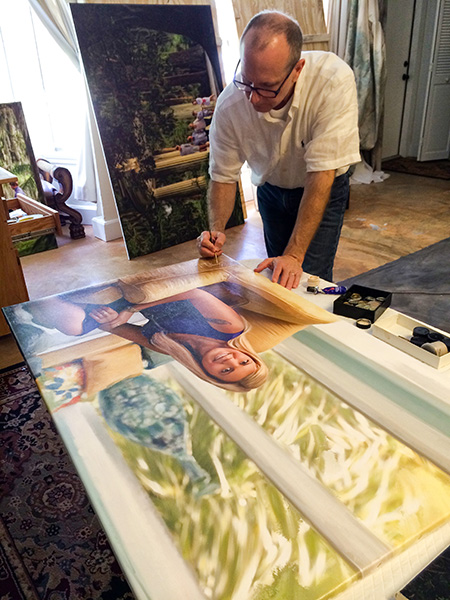
Greg is adding the finishing touch, the signature, to his art portrait.
Stay True To Yourself
I have found this to be the foundation for our success. If you are interested in being different, looking unique and standing apart look no further than yourself. There is only one you and no one else can be you! Fortunately early on in my career, I found my uniqueness through the love of art museums. You could find me in the library poring over books about artists or in galleries during family vacations. Since the late 80’s these art galleries were and are a beacon of light for my vision to fuse my love for photography with painterly galleries. Staying true to this personal love and vision has been the incredible satisfying artistically along with setting myself apart from the commodity.
Your Audience
Certainly it goes without saying that if you want a business to be successful, you need to identify who your buyer will be. The commodity is for the world of mass marketing, which is not only expensive but also difficult. Identifying, who your specific client is, will narrow the marketing beam to a laser. In our case, the audience were families that appreciated unique handcrafted works of art. This could stand true from shaving products, dining experience, tailored clothing, interior designs and high-end vacations. Here’s the think, it is a must to know who to let know you exist!
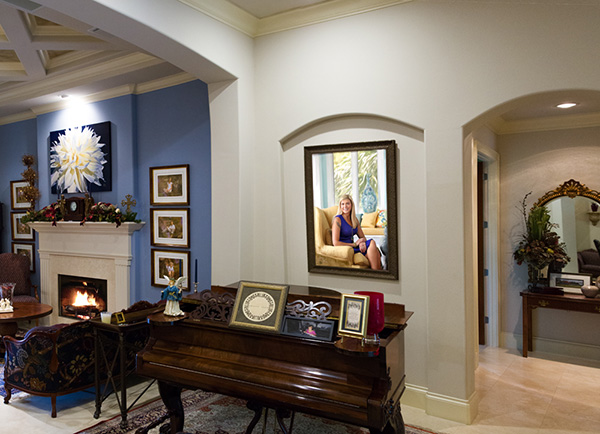
Finished portrait, framed and installed
The Product
Now here is an area that I commonly see as an issue during my many mentor sessions with students. I truly believe starting with creating one single product that defines who you are, is paramount to clearly communicating to your audience. Developing your unique product and getting feedback from your audience is critical to business success. Clearly our audience recognizes a Gregory Daniel Mixed Media Portrait as our signature commissioned product. These are uniquely designed pieces to fit the lifestyle of their beautiful home.
Final Thoughts
I encourage each of you to dig deep inside to find the true you. There is wonderful joy in knowing the business you have created was built on the foundation of your core desire. Communicating through this beautiful art form with your personal language is a gift to yourself and your audience.
Bio
Gregory Daniel M. Photog.,Cr. CPP, F-ASP, FDPE, FSA
Greg and his wife Lesa Daniel are internationally recognized for their artistry and run Gregory Daniel Portrait Artist Though he is one of the most awarded photographers in the United States, Greg has the utmost privilege of living out his passion every day alongside Lesa in operating their portrait photography galleries in both Indialantic and Titusville Florida. He has achieved both the title of Master of Photography and The American Society of Photographers Fellowship. In addition, Greg is one of the youngest members to be inducted into the prestigious Cameracraftsmen of America in 1991, proud, founding member of the International Society of Portrait Artists (ISPA) and on the Board of Directors, Professional Photographers of America.
Yours in Creative Photography, Bob
PS – Thanks to Greg for sharing his knowledge here on Successful-Photographer. If you have a photographic artist you would like to see featured let me know.
Arizona Professional Photographers Association has scheduled their Fall Fest event for November 4, 5 and 6 of this year. We’ll be traveling to Page, Arizona for lots of landscape photography opportunities. The highlight will be a tour of Secret Canyon. Secret Canyon is a beautiful slot canyon that we will access via Hummer Tour Adventures.
Also on the docket is a visit to sunrise and sunset locations that are quite beautiful. They say a picture is worth a thousand words. How about a video to describe the adventure?
Fall Festival video for Arizona PPA
There are limited spaces available for this trip. Initially, it will only be open to AZPPA members. Then if any spots are left it will be opened to non-members as well. If you would like to get on the waiting list to get in touch with me and I’ll get you hooked up.
The video and stills from this production were captured with a Lumix GX8 and Lumix GH4 cameras and assorted Lumix lenses. You may have noticed the time-lapse. It was created with the camera on a small tripod held on the dashboard with images taken every one second. Those images were processed in-camera to a 4K video at 24 frames per second. Adobe Premiere Pro the editor of choice for assembling all the pieces.
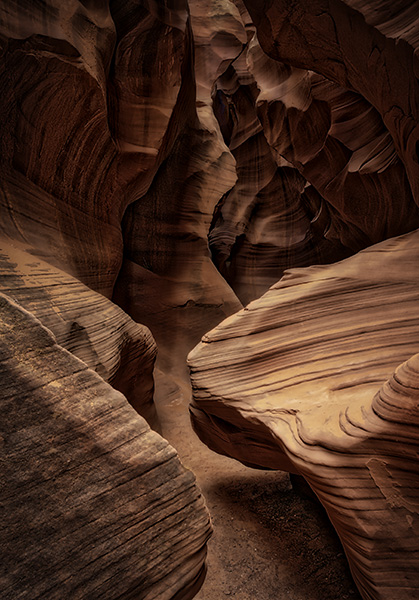
Lumix GH4 Lumix G Vario lens 7-14mm @14mm (28mm full frame equivalent) ISO 200 – Processed a three frame bracket spaced one stop apart in Aurora HDR software
Images were captured with the camera mounted on a tripod. When photographing in slot canyons you need to expand the dynamic range by capturing multiple exposures because light floods in from the open top but there are many dark corners. Being able to blend images together makes it possible to see all the varied detail that has been etched into the walls by wind and water over multiple years.
Yours in Creative Photography, Bob
PS – More information on this trip or the monthly meetings and other benefits of Arizona PPA can be found on the website
In looking for the Art quote for this week’s post, I came across these words.
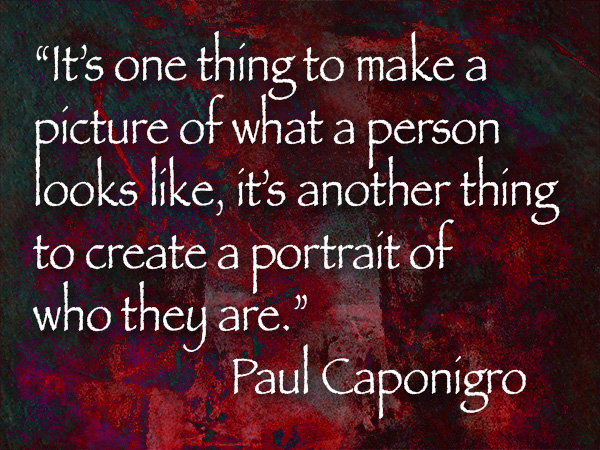
“It’s one thing to make a picture of what a person looks like, it’s another thing to create a portrait of who the are.” Paul Caponigro
But, strangely enough, this quote came from a photographer who is best known for landscape work that is imbued with mystical qualities.
Making portraits that capture personality and emotion is an art. No doubt about it. Paul’s quote got me to thinking about photographers who were able to tell deeply personal stories with their imagery in a single image. My name would not be on this list partly because I haven’t deeply worked at creating portraiture. Yes, I made photos of people for business and captured weddings and families over the years but not profound portraits. I think that’s because I don’t wish to share me with the world on too deep a level.
“What the heck are you talking about Bob??”
I believe that a great portrait is a combination of a photographer with deep empathy who is a passionate individual and not afraid to share that makes a great portrait photographer. A great portrait captures the subject but, I believe, is also a reflection of the photographer. And I just ain’t that deep. Still have some exploring to do on that front.
You may notice that all the portraitists I mentioned have varied styles. Apparently there’s more than one way to skin a cat! Maybe you can share some of your favorite portrait artists here. Be it those that are well known or unknown to the rest of the world. I’m curious to see the names on your list.
Yours in Creative Photography, Bob
PS – Are you creating portraits of your subjects? Or are you just taking pictures?
For infrared conversion of my cameras I use LifePixel. Infrared allows you to put an older camera to use and opens up a new time time of day for productive image creation.
Learn Photoshop in a fun environment. Aaron Nace applies the right amount of fun with easy to understand and follow tutorials. Actions and brushes are included with lessons!
Best embroidery ever. Give Queensboro a try, get a $20 instant credit to get started by clicking on the logo! They specialize in great quality custom logo apparel and promotional products with the best customer service.
Platypod has become a great resource for being creative in getting your camera gear easily into unusual places. As an Platypod Pro I get to work/play with the gear even before it comes out. Head over to Platypod, subscribe to the newsletter and you will get special discounts reserved only for subscribers.

 Esteban – Teresa Joy and drummer Joe Morris
 Full stage at Sound Bites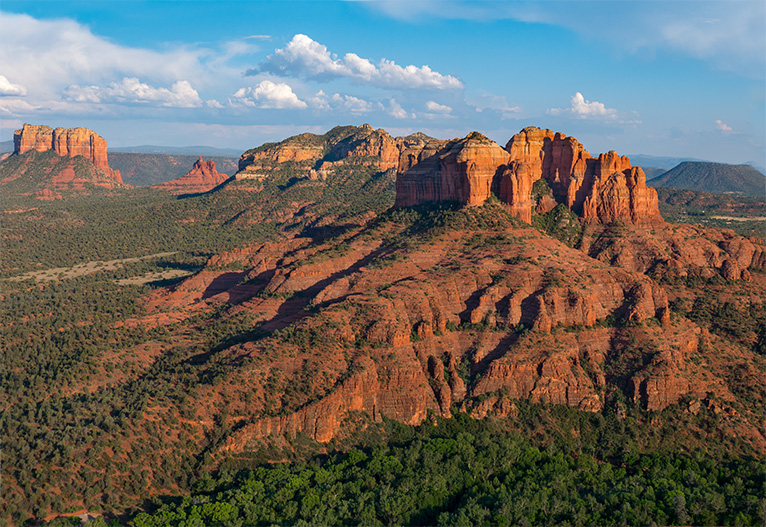

 And now YOU can help! It’s easy but necessary for all creatives to get involved.